Clear Sky Science · en
A fusion framework to bridge expert and public perception gaps in cultural heritage conservation
Why this old guild hall still matters today
Across the world, historic buildings are carefully restored based on what experts think is important about them—yet the people who visit or live alongside these places often see them quite differently. This article explores that hidden mismatch at a famous Chinese heritage site, the Huguang Guild Hall in Chongqing, and introduces a new way to blend expert judgment with the voices of ordinary visitors and online users. The goal is to make conservation not just precise on paper, but meaningful and fair in everyday life.
Two ways of seeing the same place
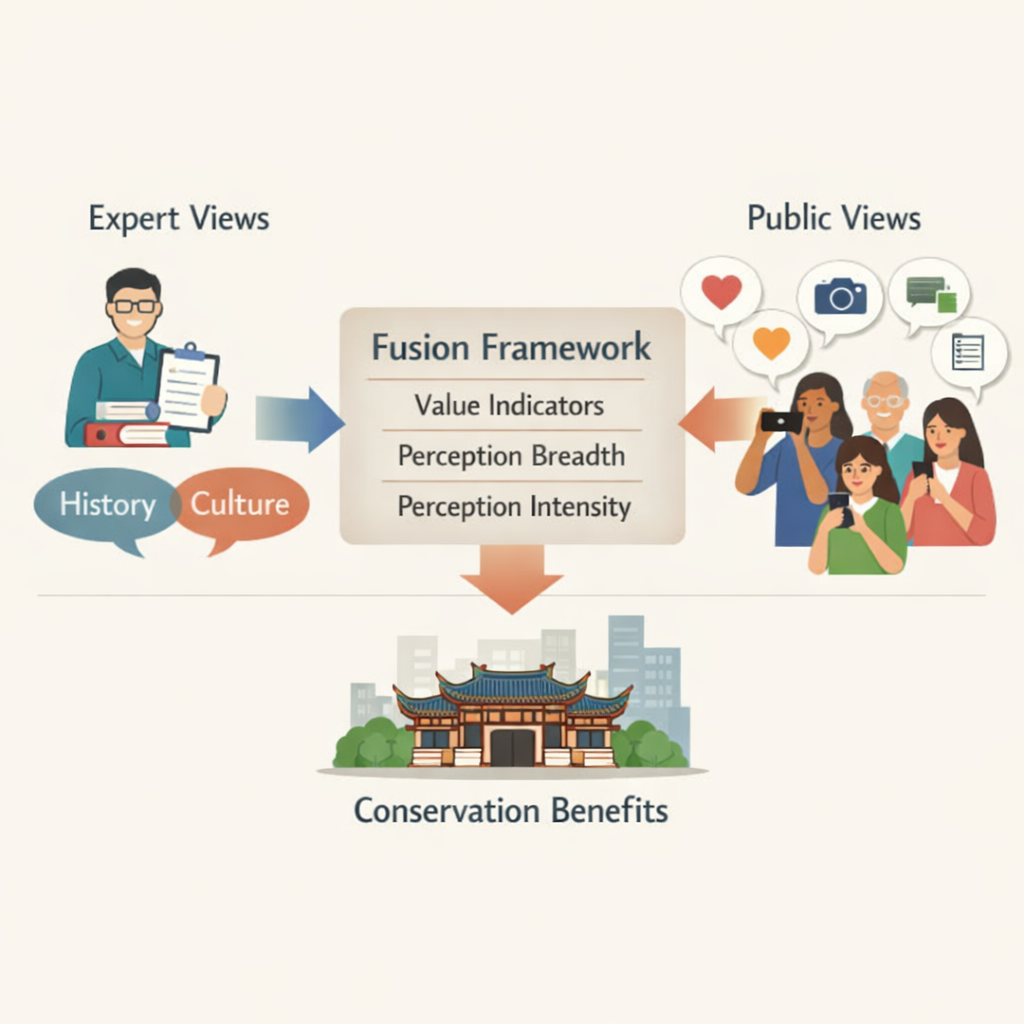
Conservation professionals usually decide what makes a historic place valuable by drawing on theory, laws, and years of fieldwork. They emphasize things like a building’s age, links to important events, or its role in local culture. Ordinary people, by contrast, respond through memories, emotions, storytelling, and practical experiences: a moving performance in an old theater, a family visit during a festival, or the feel of carved wood under the hand. The authors call the first viewpoint expert value perception and the second public value perception. Their central question is: how closely do these two ways of seeing line up, and what does that mean for how well a place is being cared for?
Turning scattered opinions into measurable signals
To answer this, the researchers propose a “Fusion Framework” that treats conservation success as the degree of overlap between expert and public views. Experts first define a detailed list of what matters at a site—such as its historical age, rare features, craft skills, symbolic meaning, and role in everyday life—and assign weights to each item to show its relative importance. Public responses are then measured along two simple dimensions. Perception breadth captures how many people mention these values in thousands of social media posts. Perception intensity reflects how accurately and completely visitors recognize the same values in structured questionnaires. By combining expert weights with these two public measures, the team calculates a conservation benefit score that expresses how effectively expert-defined values are getting through.
What the public notices—and what they miss
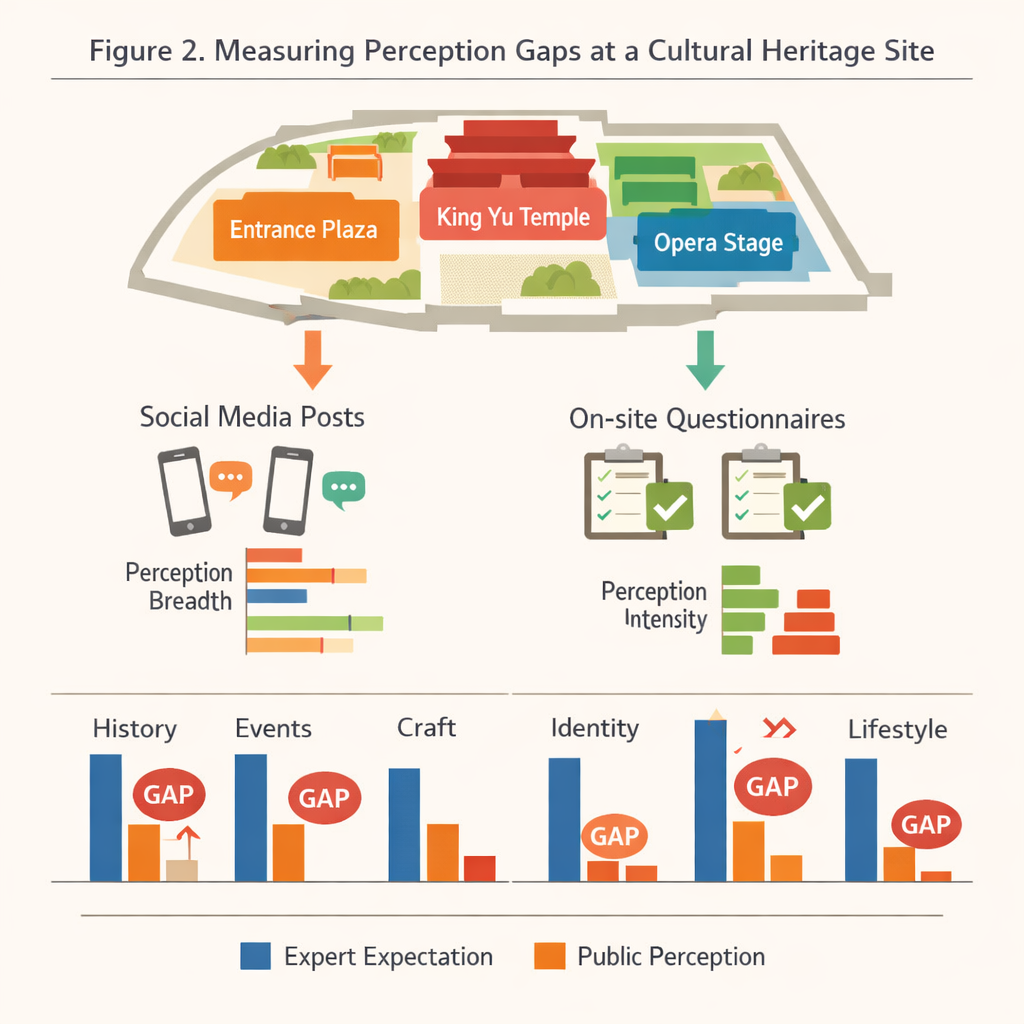
The Huguang Guild Hall, a large complex of courtyards, stages, and ancestral halls linked to major migration waves in Chinese history, served as the testing ground for this framework. The team analyzed 7,936 social media posts from popular Chinese platforms and 230 on-site questionnaires. They found that visitors eagerly talk about what they can see and feel right away: the striking architecture, the opera stage, the sense of old age, and dramatic contrasts between traditional roofs and modern skyscrapers. These visually obvious features enjoy both wide reach online and strong recognition in the survey, and they contribute most to the overall conservation benefit score.
Hidden stories and craft in the shadows
Other values, however, remain largely invisible to the public. The building’s specialized design techniques, its deeper identity links for migrant communities, and even its protected legal status are rarely mentioned on social media and are only weakly understood in questionnaires. Interestingly, some values cluster in specific spaces. The entrance plaza and nearby temple—where exhibits on historic migration, elaborate carvings, and festival activities are concentrated—produce high perception intensity. Visitors remember what they encounter there both when they arrive and when they leave, a “spatial effect” that anchors their strongest impressions. Meanwhile, social media favors visually striking scenes, a “visual effect” that amplifies what looks good in photos but not necessarily what experts see as most important.
Bridging the gap for fairer heritage care
By comparing expert expectations with what the public actually sees and shares, the Fusion Framework exposes where communication is working and where it is not. The authors argue that conservation should not chase perfect agreement, but use these gaps as starting points for dialogue and better design: clearer visual explanations of complex features, more engaging activities around less-understood themes, and inclusive programs that reach beyond typical tourist groups. In plain terms, the study shows that a heritage site is most successful when the stories experts want to protect are also the stories people can recognize, enjoy, and pass on. This framework offers a practical way to track that alignment over time and to guide more equitable, people-centered preservation.
Citation: Cheng, Y., Mao, H., Ho, P. et al. A fusion framework to bridge expert and public perception gaps in cultural heritage conservation. npj Herit. Sci. 14, 46 (2026). https://doi.org/10.1038/s40494-026-02317-w
Keywords: cultural heritage conservation, public perception, social media analysis, historic buildings, urban heritage