Clear Sky Science · en
Feasibility of cracking granite with molten sodium carbonate as a mining technique in ancient egypt
How Did They Shape Such Hard Stone?
Visitors to Egyptian sites often marvel that ancient builders carved giant obelisks and sarcophagi from granite, a stone so hard that even modern tools struggle with it. This paper explores a provocative idea: instead of relying only on hammering and chiseling, New Kingdom Egyptians may have cracked granite using a chemical helper—molten natron, a naturally occurring form of sodium carbonate—to speed the work and control the stone’s breakage.
Clues Hidden in an Unfinished Obelisk
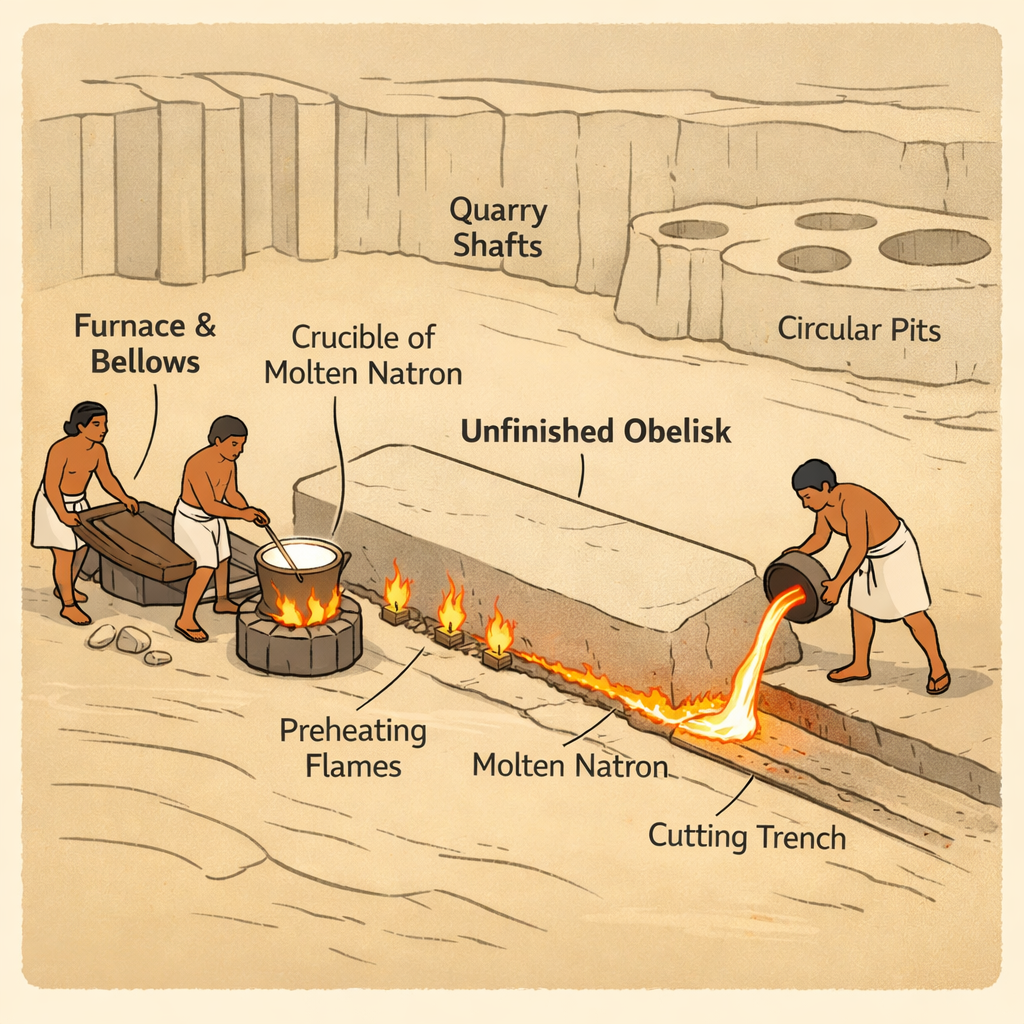
At Aswan, a colossal obelisk still lies attached to the bedrock, abandoned mid-quarry. Around it are narrow vertical shafts and rows of round, bowl-like pits that don’t fully match explanations based on simple pounding, wedges, or fire-setting with wood alone. Fire can break rock, but it usually produces random fractures and jagged blocks, not the regular curved shapes seen at the site. The author argues that these shapes fit better with a more controlled, repeated process in which heat and a reactive molten substance work together to weaken the granite before it is pried away.
A Chemical Partner for Heat
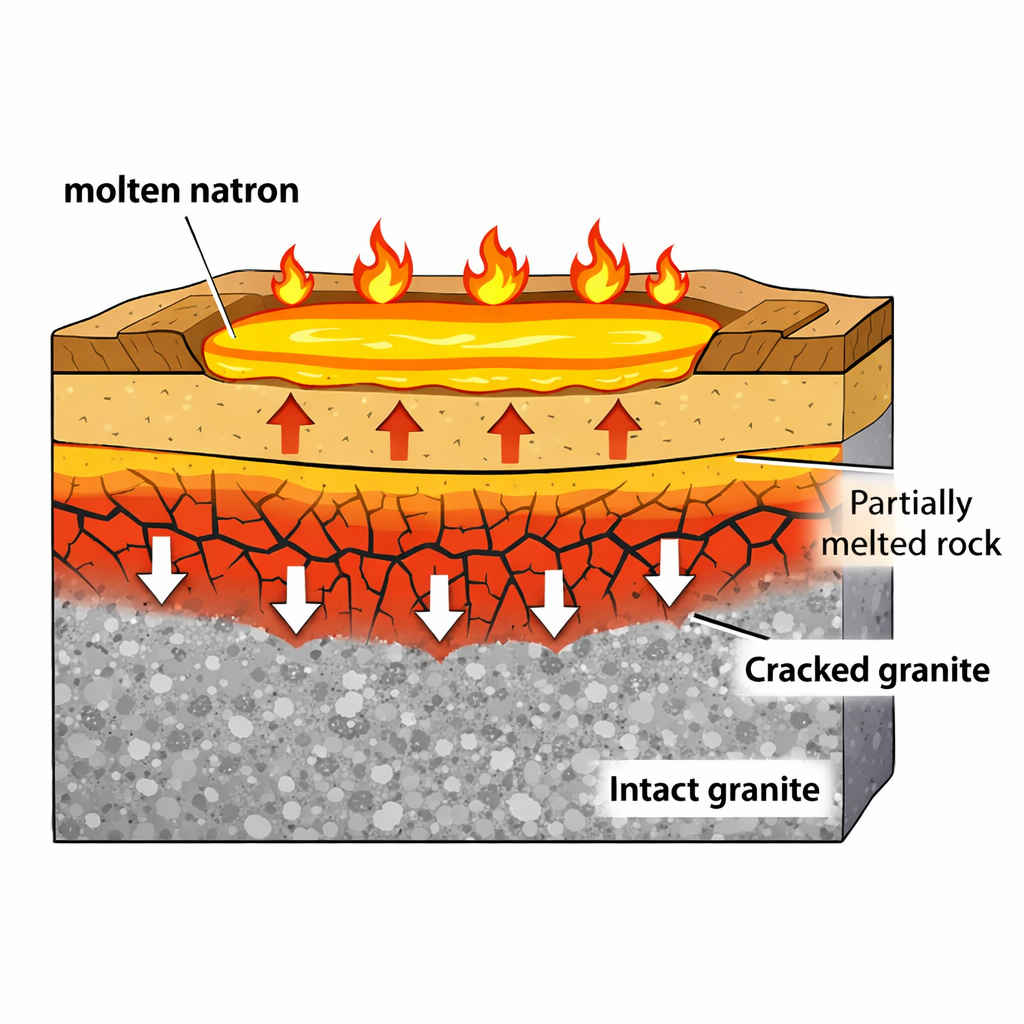
Granite is made of tough minerals such as quartz and feldspar. Laboratory experiments in this study show that when sodium carbonate is heated above its melting point, it becomes a runny liquid that reacts strongly with quartz and several feldspars. In test crucibles, molten sodium carbonate turned clean sand into a glassy material, and when mixed with granite pieces, it dissolved some minerals into a bluish-green, water-soluble product while leaving others unchanged. A separate experiment poured the molten liquid onto a granite block that had been roughened beforehand. After cooling, the stone showed a web of fine cracks; a few blows with a wooden handle were enough to shatter it into small fragments, revealing how heat shock plus chemical attack could drastically weaken such hard rock.
Re-Reading Ancient Texts and Art
The paper argues that Egyptians had both the materials and the expertise to do this. Natron was abundant in Egyptian salt lakes and already used for glass-making, glazes, and mummification, where it was heated in furnaces hot enough to melt it. A Middle Kingdom quarry inscription describes separating a sarcophagus block using natron and fire, a phrase the author reinterprets as a literal recipe rather than a poetic metaphor. Wall paintings from the tomb of Rekhmire, a high official under Thutmose III, show workers operating charcoal-fired furnaces with foot bellows, carrying white chunks that resemble natron, and pouring a glowing liquid onto large red stone blocks that match quartzite sarcophagi. The author proposes that these scenes record the controlled heating and hollowing of massive stone coffins using molten natron and oil flames, not the casting of metal doors as often assumed.
A Step-by-Step Quarrying Method
Drawing these threads together, the study outlines a practical quarrying sequence. First, workers would roughen and clean the granite surface with hard stone balls. Next, they built a low clay wall to hold liquids and coated the area with castor oil, which burns hot and clean, to preheat a shallow groove. From a nearby furnace, they carried crucibles of superheated molten natron and poured the liquid into the hot groove. The intense heat and chemical reaction would partially melt a thin layer of mineral grains and drive cracks deeper into the rock below. After cooling, they removed the weakened material and repeated the cycle, stepping the process along and downward in small squares to form deep trenches around an obelisk blank. Simple wedge-and-feather splitting could then separate pre-cracked sections more easily and cleanly than pounding alone.
What This Means for Ancient Engineering
Weathering, rare but intense rainstorms, and the solubility of sodium salts mean that no obvious chemical traces remain on the quarry surfaces today. Still, the combined archeological, experimental, and textual evidence suggests that New Kingdom Egyptians may have mastered a sophisticated “thermal-chemical” approach to quarrying: using molten natron to focus heat, weaken minerals, and guide fractures in granite. For a lay observer, this reframes Egypt’s stone monuments not just as feats of brute-force labor, but as products of inventive materials science and careful temperature control, centuries before modern chemistry gave such techniques formal names.
Citation: Yi, X. Feasibility of cracking granite with molten sodium carbonate as a mining technique in ancient egypt. npj Herit. Sci. 14, 51 (2026). https://doi.org/10.1038/s40494-026-02315-y
Keywords: ancient Egyptian quarrying, granite cracking, molten natron, obelisk construction, archaeological materials science