Clear Sky Science · en
Exploring the drivers of users' adoption of museum digital humans
Why virtual museum guides matter
Museums around the world are experimenting with “digital humans”—lifelike virtual guides that talk, gesture, and tell stories about artifacts. This study asks a simple but important question: what actually makes people want to keep using these virtual guides? By looking at how visitors think and feel while interacting with a popular Chinese museum avatar named Ai Wenwen, the research uncovers the mix of practical benefits and emotional experiences that turn a one-off curiosity into a tool people genuinely value.
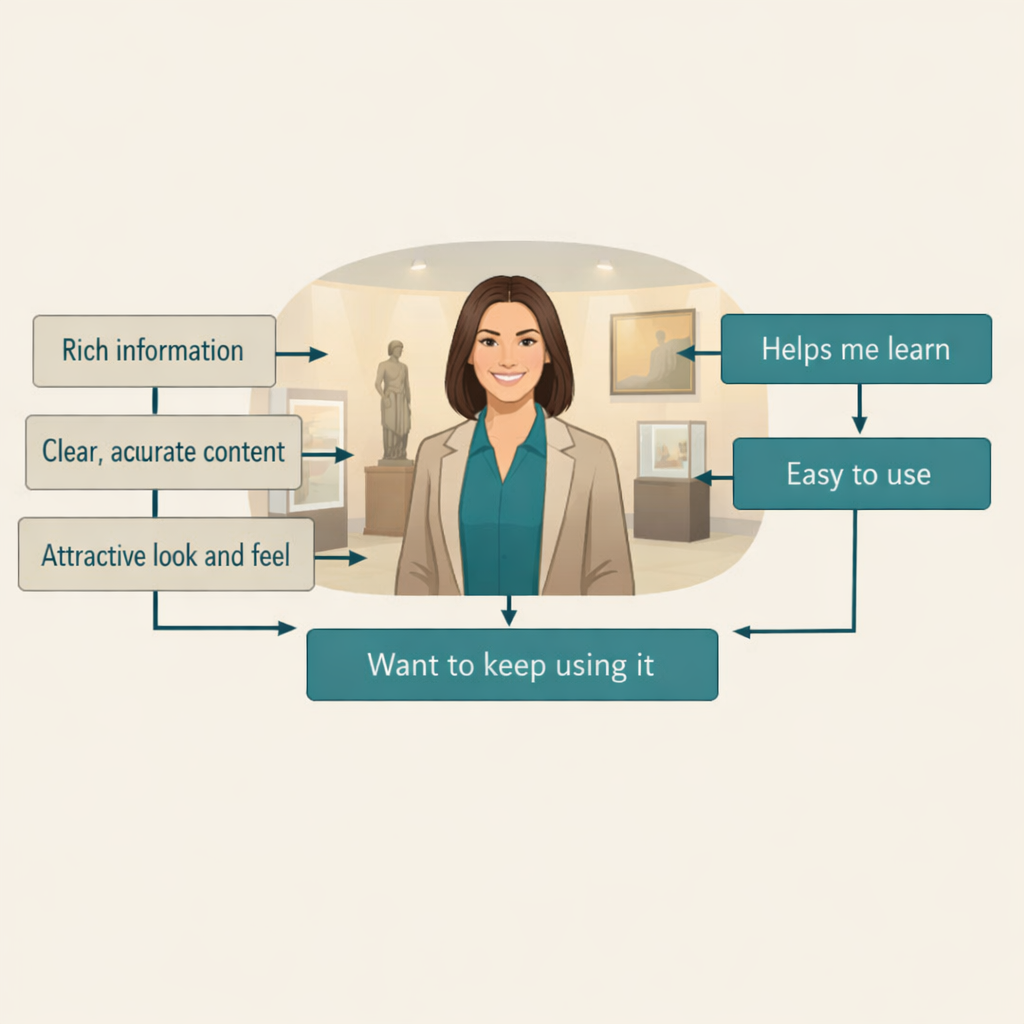
From tools to experiences
For decades, technology experts have explained why people adopt new systems using the Technology Acceptance Model, which focuses on two ideas: whether something is useful and whether it is easy to use. That approach works well for office software, but it misses what makes a digital museum guide special—its ability to entertain, move, and immerse visitors. The authors argue that when the goal is cultural experience rather than workplace efficiency, we must consider not only what people think about a technology, but also how it makes them feel. Museums are shifting from simply displaying objects to crafting experiences, and digital humans sit at the center of that shift.
What the researchers set out to test
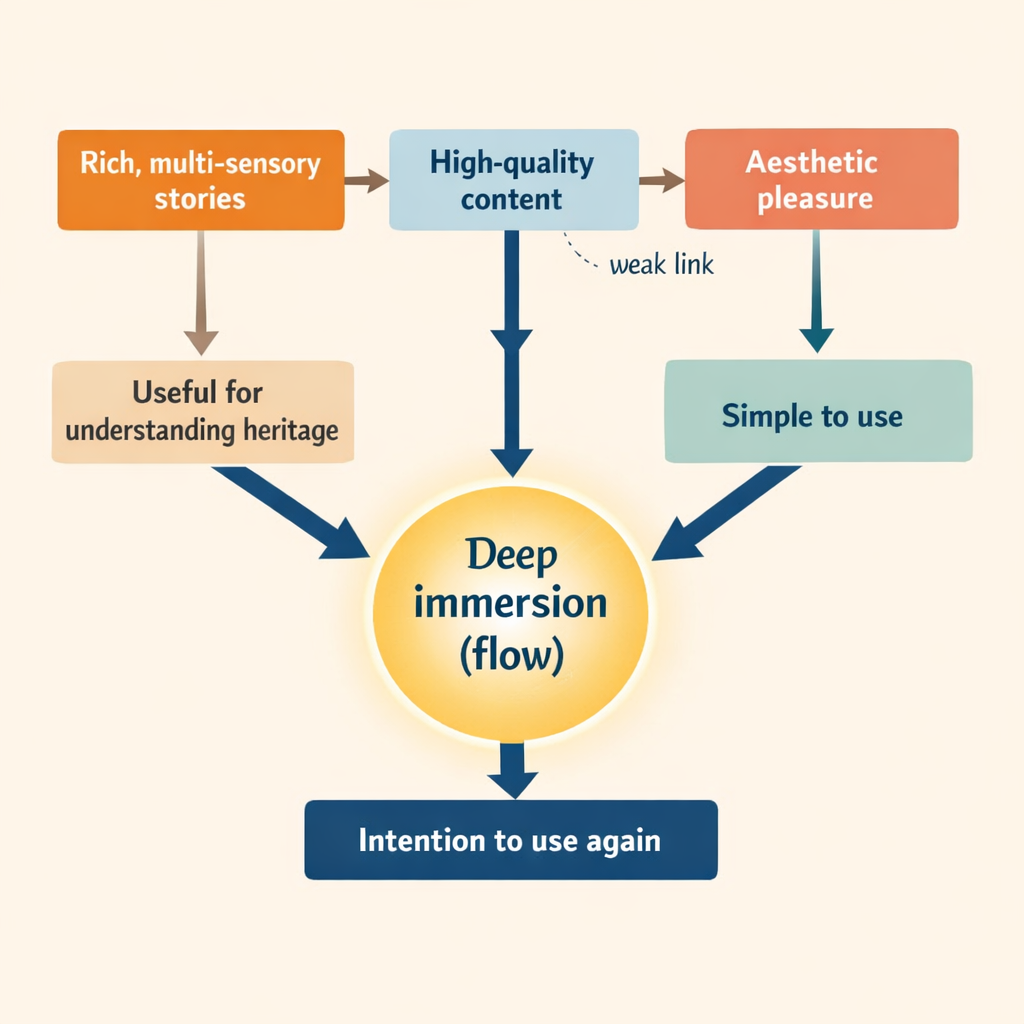
The team built a new “dual-path” model that combines thinking and feeling. On the thinking side, they kept the familiar ideas of usefulness (does this help me understand heritage?) and ease of use (is it simple to handle?). On the feeling side, they focused on aesthetic experience (is it visually and emotionally pleasing?) and flow, a state of deep absorption in which people lose track of time. They also examined two content features: information richness (how many kinds of cues—speech, gestures, visuals—are woven into the story) and information quality (how clear, accurate, and well-organized the facts are). All of these elements were linked together in a chain meant to explain why someone intends to keep using a digital human guide.
How the study was carried out
To test their ideas, the researchers asked 265 university students in China to watch short videos from the National Museum of China’s “Ai Kan Wenwu” series, in which the digital human Ai Wenwen introduces artifacts. Afterward, participants filled out a detailed questionnaire rating their experience on a seven-point scale. The questions measured how rich they found the information, how trustworthy and coherent the content seemed, how attractive they found the design, whether Ai Wenwen felt helpful and easy to use, how strongly they experienced flow, and whether they wanted to use similar guides in the future. Advanced statistical modeling was then used to see which factors mattered most and how they interacted.
What drives people to come back
The results paint a clear picture. Rich, multimodal storytelling strongly boosted both perceived information quality and aesthetic experience. High information quality made people see the guide as more useful and easier to use, but surprisingly it did not directly deepen their sense of flow. Aesthetic experience, by contrast, influenced everything: it increased feelings of usefulness and ease, and it directly fueled flow. Ease of use also fed into both usefulness and flow. Finally, usefulness, ease of use, and especially flow all pushed people toward wanting to use digital humans again. When the researchers compared models, they found that simply adding more technical and informational details hardly improved predictions; adding the emotional and immersive elements increased explanatory power substantially.
What it all means for future museum visits
For a layperson, the main takeaway is straightforward: people stick with digital museum guides not just because they are informative, but because they are beautiful, enjoyable, and absorbing. Accurate facts and clear structure are essential—they build trust and make interaction smooth—but it is the combination of engaging design and a sense of “being carried away” that truly anchors long-term interest. The study suggests that museums should treat digital humans less like talking labels and more like performers: crafted to tell rich stories, spark emotion, and create memorable, immersive encounters with cultural heritage.
Citation: Mo, J., Chen, H., Ye, C. et al. Exploring the drivers of users' adoption of museum digital humans. npj Herit. Sci. 14, 43 (2026). https://doi.org/10.1038/s40494-026-02313-0
Keywords: digital museum guides, virtual humans, cultural heritage, museum technology, visitor experience