Clear Sky Science · en
Geomaterials for medicine or alchemy in a Western Han (206BCE–8CE) Tomb at Hongtushan, Shandong
Ancient stones with hidden stories
Long before modern chemistry, people experimented with colorful rocks and powders to heal the sick, seek long life, and honor the dead. In a lavish Western Han dynasty tomb in eastern China, archaeologists uncovered an unusually rich collection of such materials—bright red powders, pale stones, and even oyster shells—carefully arranged beside medicine-making tools. By studying these relics with modern instruments, researchers can glimpse how early Chinese healers and alchemists understood the natural world, and how far rare materials traveled to serve medical and spiritual needs.
A royal tomb turned laboratory
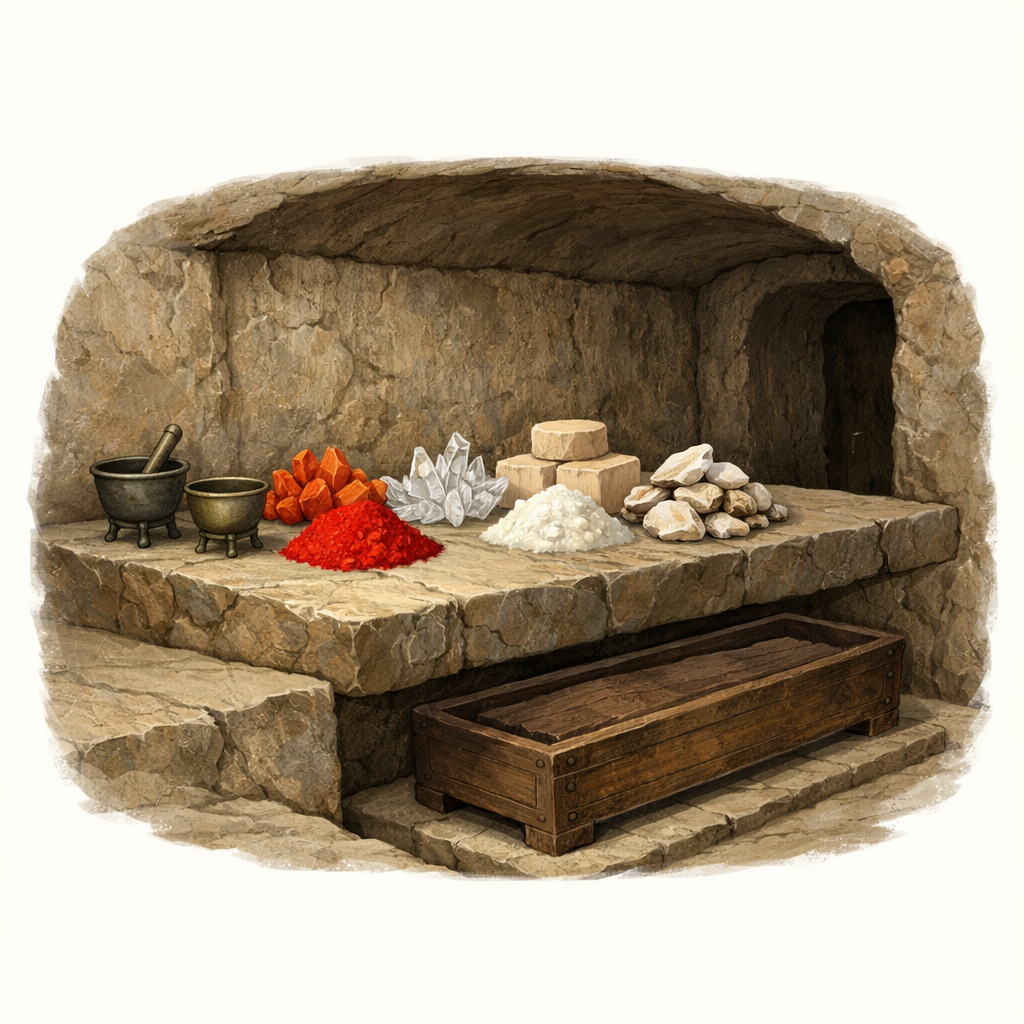
The tomb at Hongtushan in Shandong Province, dating to the Western Han period (206 BCE–8 CE), was carved into a hillside and probably belonged to a person of princely rank. At the back of the burial chamber, a special stone platform had been built near the head of the coffin. On this narrow shelf, archaeologists found about twenty blocks and grains of minerals, as well as powder that had mixed into the surrounding soil over time. Bronze mortars and pestles, spoons, a knife, a tripod cauldron, a grindstone and slab, and storage vessels sat right beside the minerals. This setup looks less like simple grave goods and more like a tiny pharmacy or alchemical workshop placed in the afterlife.
Reds, whites, and shells on the stone shelf
Close examination showed that the tomb contained several distinct kinds of geomaterials. There was vivid red cinnabar, a mercury sulfide mineral, often seen as loose grains; orange-red realgar, an arsenic sulfide; soft, soapy-feeling talc; fine white kaolinite clay in two forms (a weathered variety and a hydrothermal variety with additional minerals); clear quartz crystal; white calcite in both crystal and massive forms; and fragments of semi-fossilized oyster shell. These finds echo descriptions in early Chinese medical and alchemical texts, which list more than forty medicinal stones and earths. Names such as Dan or Dānshā for cinnabar, Huáshí for talc, and Bái Shíyīng for white quartz-like stones appear to match the materials from the tomb, suggesting that the occupant was supplied with recognized remedies rather than random rocks.
Reading the rocks with modern tools
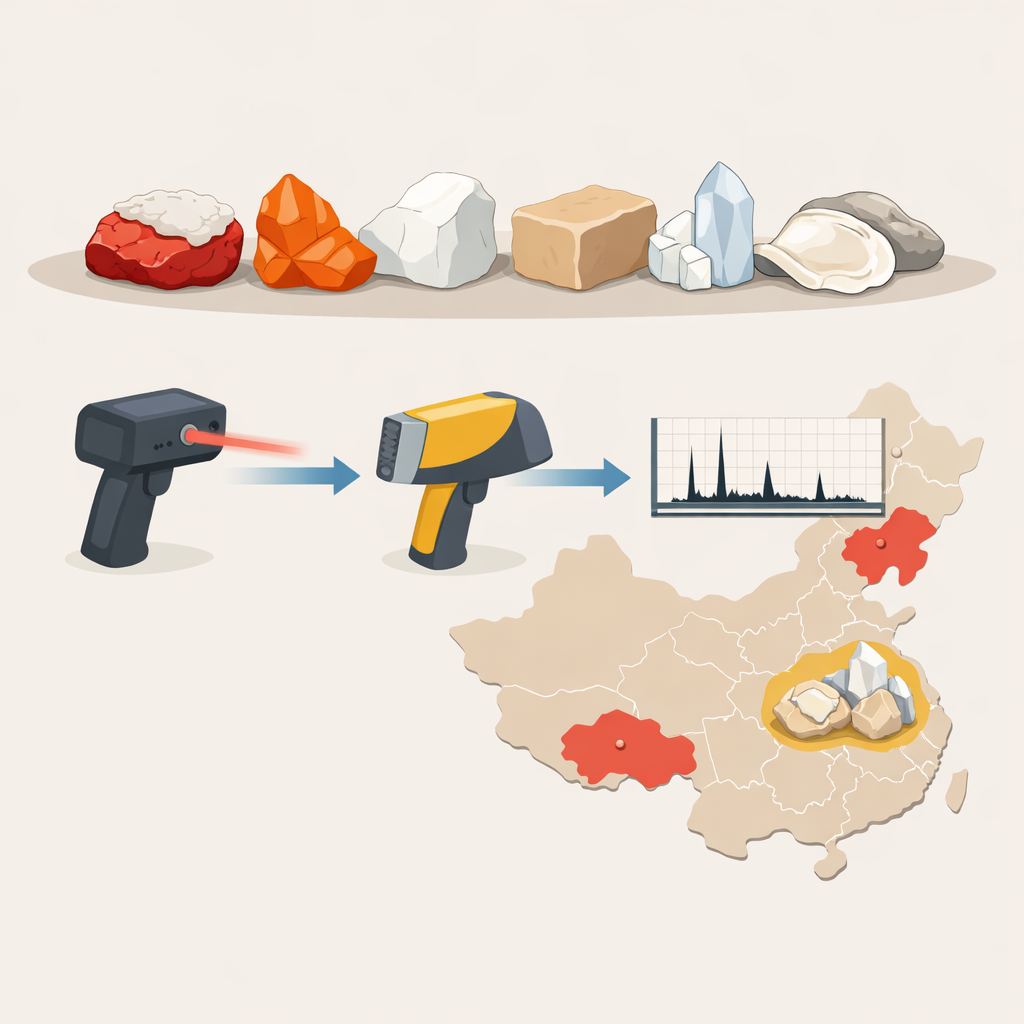
To understand exactly what these materials were and where they came from, the team combined several non-destructive techniques. Optical microscopes and image analysis revealed the size, shape, and wear of cinnabar grains, showing that many had been rounded by transport in water, while others still preserved sharp crystal faces. Raman spectroscopy, which reads the vibrational “fingerprints” of crystals, identified each mineral and detected barite, a barium sulfate, tightly attached to some cinnabar grains. X-ray fluorescence measured the elements present, and X-ray diffraction confirmed the detailed crystal structures, especially for the clays. An electron microprobe then zoomed in on tiny amounts of selenium within the cinnabar—a subtle but important clue to its geological origin.
Tracing long-distance and local supply chains
By comparing these chemical fingerprints with modern geological surveys, the researchers inferred where the tomb’s minerals were likely mined. The cinnabar’s association with barite and its selenium signature closely match deposits in the Upper Yangtze mercury belt, especially northeastern Guizhou, more than 1000 kilometers from the tomb. Historical records also point to this region as a major cinnabar source in the Han era. Realgar probably came from western Hunan, another distant area famed for arsenic ores. In contrast, minerals such as quartz, talc, and kaolinite most likely came from nearer deposits in Shandong and neighboring provinces, while the oyster shells must have been carried inland from China’s eastern coast. Together, these clues reveal a web of long-distance trade and regional sourcing that supplied elite medical and ritual practices.
Early science in stone form
When the tomb’s stones are set alongside early medical writings, a picture emerges of Han dynasty practitioners who paid close attention to color, texture, shape, and behavior of materials, and who sorted them into named categories with specific uses. They clearly distinguished different white minerals, reused the same names for stones with similar appearances, and reserved special terms for powerful substances such as cinnabar and realgar that featured in both medicines and quest-for-immortality elixirs. While their knowledge did not match modern mineralogy, it laid some of the groundwork for later Chinese ideas about matter. This study shows that by pairing cutting-edge analysis with ancient texts, we can reconstruct how people two thousand years ago explored the boundary between medicine, technology, and belief—using the very same rocks that still lie on a dusty stone shelf in a royal tomb.
Citation: Weng, X., Liu, Q., Yin, M. et al. Geomaterials for medicine or alchemy in a Western Han (206BCE–8CE) Tomb at Hongtushan, Shandong. npj Herit. Sci. 14, 37 (2026). https://doi.org/10.1038/s40494-026-02312-1
Keywords: ancient Chinese medicine, Han dynasty tomb, cinnabar and realgar, archaeological science, geomaterials