Clear Sky Science · en
Designing a traditional village cluster protection-utilization system via complex network analysis: Qiandongnan case study
Why village clusters matter to all of us
Across the mountains of Qiandongnan in southwest China, hundreds of traditional villages preserve wooden houses, festivals, songs, and farming ways that have survived for centuries. Yet these communities now face tourism pressures, migration, and uneven investment. This study asks a simple but powerful question: instead of protecting each village in isolation, what happens if we treat them as a connected web and manage them as a group? The answer offers lessons for how to safeguard living cultures while supporting local livelihoods, in China and around the world.
A mountain region rich in living heritage
Qiandongnan Prefecture is one of the world’s important regions for protecting indigenous cultures. It contains 415 nationally recognized traditional villages, many inhabited by Miao and Dong ethnic groups. Because the area is mountainous, most villages are perched on slopes or in river valleys, balancing defense, access to forest resources, farming land, and travel routes. Government programs have listed and funded these villages since 2012, but the sheer number and wide spread mean that focusing on single sites has been slow and often ineffective. Villages tend to compete rather than cooperate, even though together they form a unique cultural landscape of architecture, festivals, music, and farming systems. 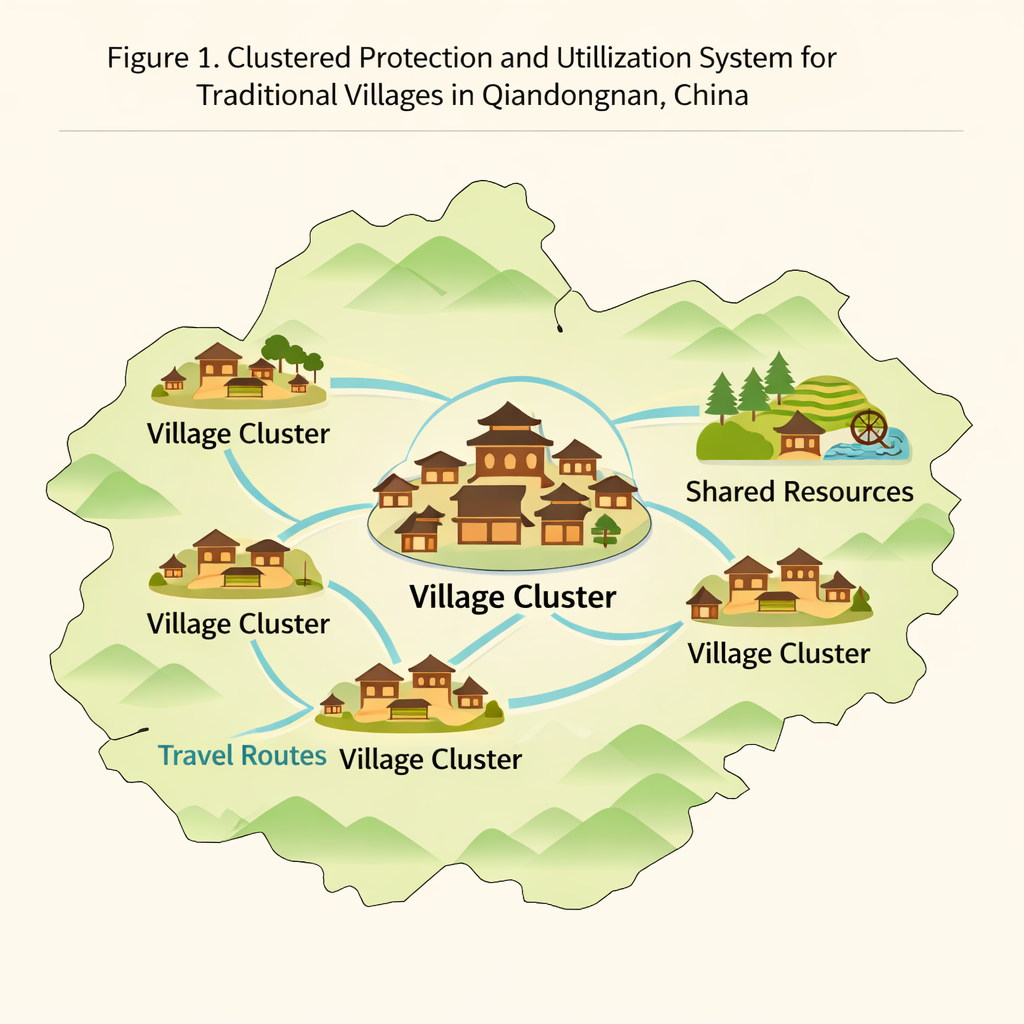
From dots on a map to a living network
The researchers used tools normally applied to study social media or transport systems and turned them on the countryside. First, they analyzed where villages are located using mapping methods that highlight clusters and dense areas. Then they built a "gravity" model that estimates how strongly any two villages are connected based on distance, road access, tourism activity, cultural value, and government support. If the pull between two villages was high enough, the team drew a link between them, creating a network where each node is a village and each line is a likely path of people, goods, or visitors. By examining the shape of this network, they could identify tightly knit groups, central hubs, and outliers on the fringe.
Revealing cores, bridges, and fragile links
The resulting picture is a multi-centered, radial web rather than a single dominant hub. About one fifth of the villages sit in core positions with many strong connections; others form intermediate rings or remote peripheries. The network is only moderately robust: removing a small number of key villages would break it into disconnected pieces, and overall density of links is low. At the same time, some villages play special roles as coordinators, gatekeepers, or liaisons, acting like bridges between otherwise separate groups. When the researchers compared this structure with an independent score of each village’s development potential—which combines heritage value, tourism facilities, access, and government backing—they found a very strong match. Villages that were well connected and played central roles tended to have higher potential for sustainable growth.
Designing a cluster-based protection system
Building on these insights, the authors propose a Cluster Protection and Utilization System, or CPUS. Instead of planning by city or county boundaries, they group the 415 villages into eight management units that follow actual patterns of interaction. Within these units, they distinguish three broad zones: core driving areas with strong networks and high potential; boutique development areas suited to focused, high-quality tourism; and deep experience areas where visitors can explore more remote landscapes and cultures. They also rank 45 key villages to receive priority investment, and set three levels of protection—from strict preservation of layout and skylines to more flexible improvement where heritage is weaker. By simulating upgrades in these key nodes, they show that the village network becomes denser, more balanced, and more stable, while using resources about 23% more efficiently than conventional, scattered approaches. 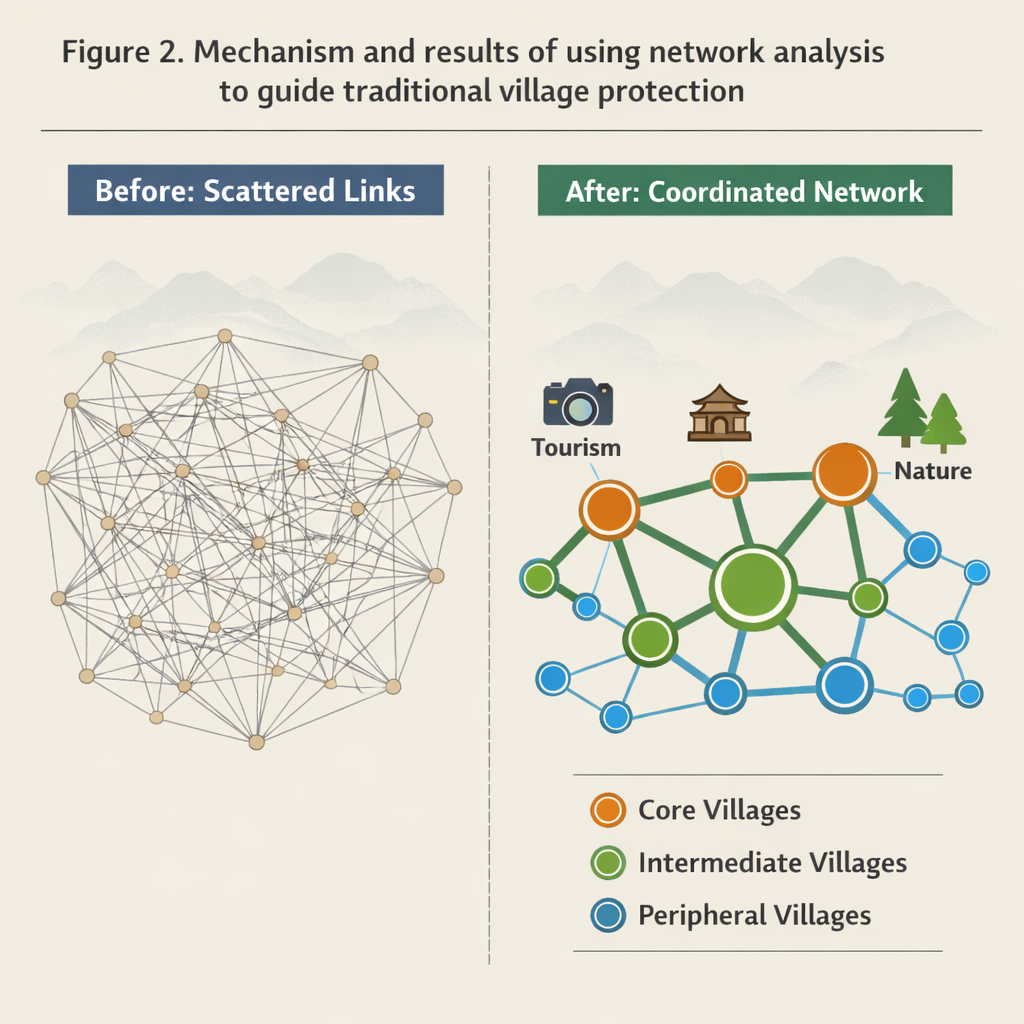
What this means for village futures
For non-specialists, the core message is intuitive: traditional villages thrive not just on their own strengths but on how they connect to neighbors. Treating them as a coordinated cluster—sharing visitors, services, and cultural events—can protect fragile heritage more effectively while spreading economic benefits. The CPUS framework offers a step-by-step way to do this, from mapping where villages actually interact, to choosing which ones should be carefully preserved, gently upgraded, or developed as gateways for tourism and education. Although rooted in Qiandongnan, the approach could be adapted to other heritage-rich regions worldwide, helping planners move beyond isolated showpieces toward vibrant, connected cultural landscapes.
Citation: Fan, J., Huang, Z. & Zhang, B. Designing a traditional village cluster protection-utilization system via complex network analysis: Qiandongnan case study. npj Herit. Sci. 14, 59 (2026). https://doi.org/10.1038/s40494-026-02311-2
Keywords: traditional villages, cultural heritage, rural tourism, network analysis, Qiandongnan