Clear Sky Science · en
Investigating the hidden content of Tibetan bronze statues using modern neutron imaging techniques
Hidden Treasures Inside Sacred Statues
Many Tibetan bronze statues are more than beautiful works of art—they are sealed containers for sacred objects that believers are never meant to see. Until recently, the only way to find out what was inside them was to cut them open, destroying both their religious and historical value. This study shows how beams of subatomic particles called neutrons can act like a gentle kind of vision, allowing researchers to look inside these bronzes without harming them, and revealing the hidden worlds carefully placed there by generations of worshippers.
Why Scientists Want to See Inside
For Tibetans in both Buddhism and the Bon tradition, statues are not just decorations. During special rituals, monks fill hollow statues with prayer scrolls, blessed pills, fragrant herbs, precious stones, and other offerings before sealing them forever. These contents can differ from one religious lineage, monastery, or historical period to another, so understanding what is inside a statue can teach scholars when it was prepared, by whom, and for what purpose. Classic methods—studying texts, styles, and inscriptions—cannot reach the interior. Cutting a statue open is almost never allowed, so researchers have long been left to guess about the hidden contents.
A New Kind of Gentle Vision
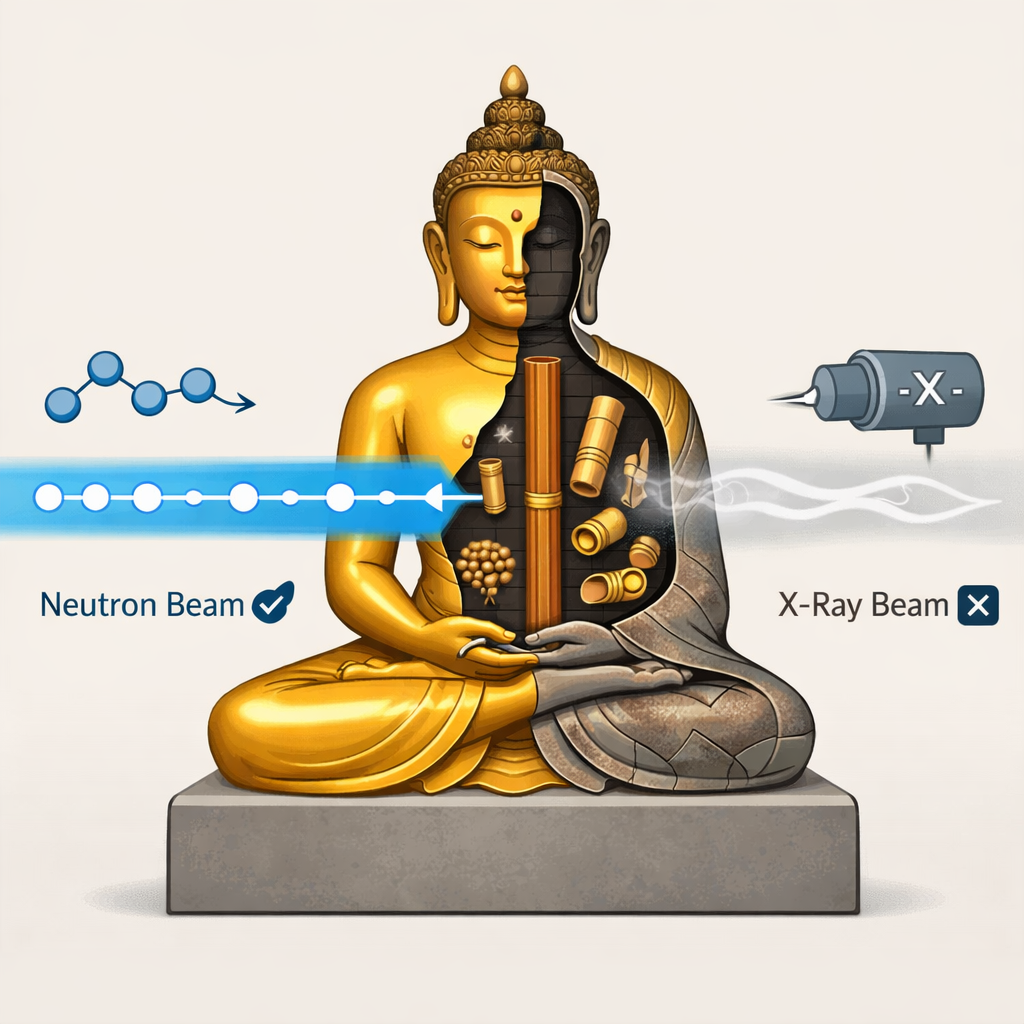
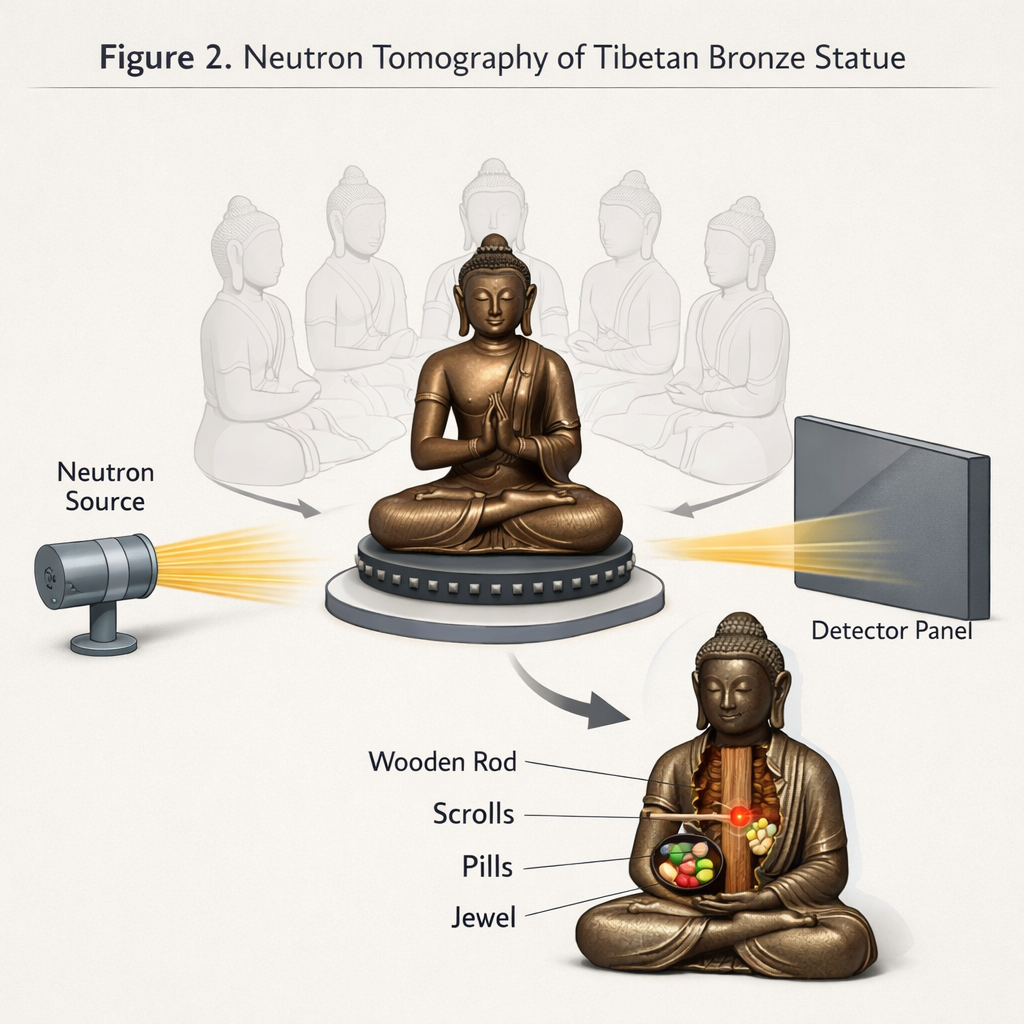
Neutron imaging offers a way around this problem. Like X‑rays, neutrons can pass through solid objects, creating images that show what lies inside. But where X‑rays are easily blocked by metals such as copper and iron, neutrons slip through bronze while reacting strongly with materials that contain a lot of hydrogen, such as wood, paper, cloth, and many organic powders. In the images, these organic fillings stand out clearly against the metal shell. The team used two related techniques: radiography, which makes a flat “shadow picture” from one direction, and tomography, which takes hundreds of images as the statue slowly rotates and then uses computer programs to build a full three‑dimensional interior map.
Peering Inside Three Sacred Figures
The researchers applied these methods to three bronze statues: a modern Bon statue of the goddess Sherab Chamma, and two older Buddhist statues of the Fifth Dalai Lama and the master Dagpa Sherab. In the Sherab Chamma statue, tomography revealed a tall wooden “life tree” running from base to head, wrapped with six rolled paper scrolls. At the base, inside the lotus throne, the team saw clusters of tiny, irregular spheres identified as sacred healing pills known as mani rilbu, along with other organic fillings. In the Fifth Dalai Lama statue, the interior was tightly packed with loose scrolls but no central wooden rod. The head was filled with a concentrated cluster of the same type of sacred pills, embedded in now‑degraded powders and textiles. In the Dagpa Sherab statue, the inner arrangement combined features of both: a wooden rod, several tall free‑standing scrolls, and, uniquely, a small bead‑like jewel at the crown of the head—likely a piece of red coral, a gemstone with strong religious symbolism in Tibet.
What the Hidden Contents Can Tell Us
Because the statues cannot be opened, neutron images cannot prove exactly when each internal object was placed inside; statues may have been re‑consecrated and refilled over the centuries. The technique also cannot yet identify specific herbs, fabrics, or inks, especially when they are very small or tightly packed. Even so, the images provide a remarkable amount of information: shapes, sizes, arrangements, and materials of the inner objects, and even details of the casting quality of the metal shell. Historians and religious scholars can combine this with written sources and fieldwork to better understand how different Tibetan communities practiced their faith, what they valued as worthy offerings, and how long‑standing rituals evolved over time.
Bringing Past and Present Together
In simple terms, this work shows that it is now possible to “look inside” centuries‑old sacred statues without touching a chisel or breaking a seal. Neutron imaging acts like a respectful, non‑invasive scan, revealing wooden cores, prayer scrolls, blessed pills, and even tiny gemstones hidden in solid metal. As more statues are examined and the results shared in public databases, researchers hope to build a much richer picture of Tibetan religious life while keeping these precious objects intact for the communities that still cherish them.
Citation: Frame, E.A., Lehmann, E.H., Trtik, P. et al. Investigating the hidden content of Tibetan bronze statues using modern neutron imaging techniques. npj Herit. Sci. 14, 38 (2026). https://doi.org/10.1038/s40494-026-02308-x
Keywords: Tibetan bronze statues, neutron imaging, cultural heritage, Buddhist rituals, non-destructive analysis