Clear Sky Science · en
Analyzing the surface black discoloration of oracle plastrons from the Taijiasi Site, China
Ancient shells, modern mystery
More than three thousand years ago, diviners in China heated turtle shells to ask questions about war, harvests, and the will of ancestors. Today, many of these inscribed shells are treasured in museums and storerooms. At the Taijiasi Site in Anhui Province, however, archaeologists noticed a puzzling problem: the surfaces of many oracle turtle plastrons had turned patchy black in ways that could not be explained by ancient fire. Understanding this dark coating matters not only for the appearance of these rare objects, but also for how well they can be studied, preserved, and displayed.
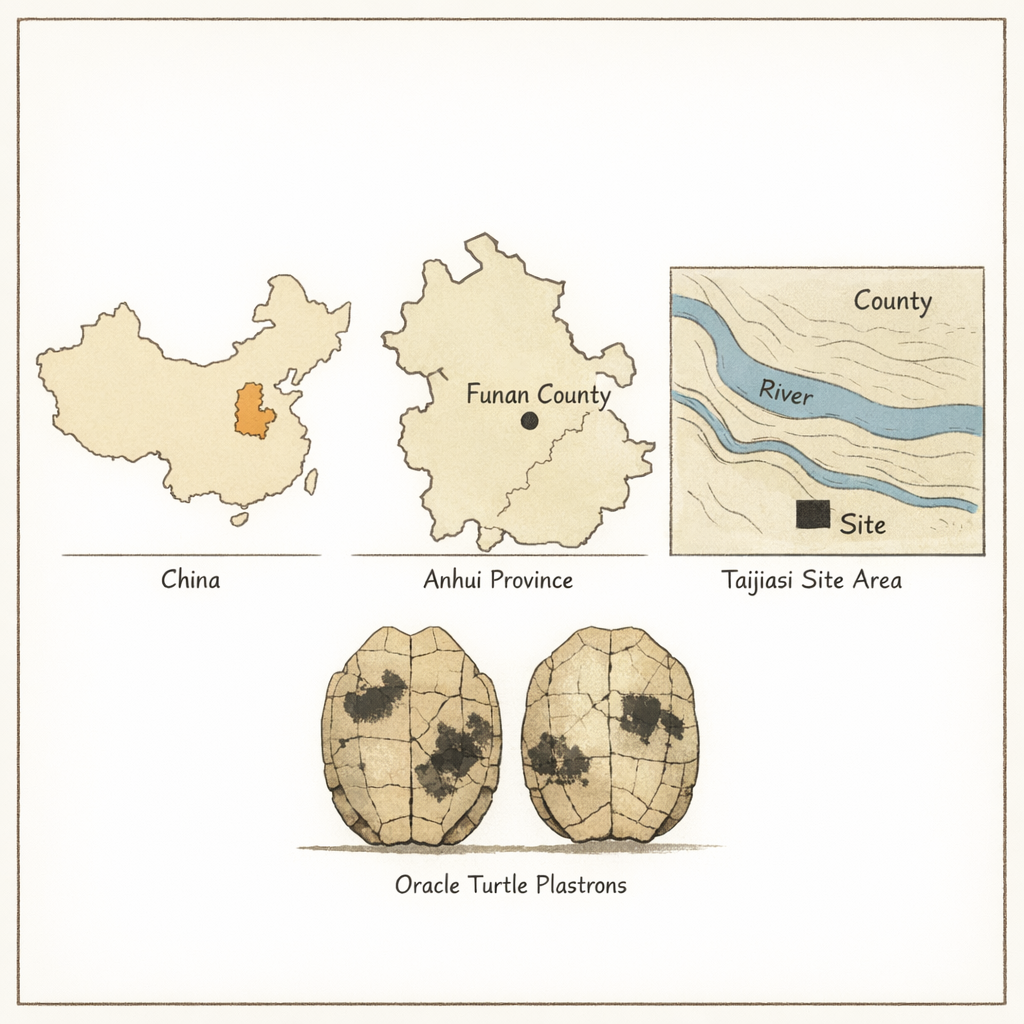
Where the shells come from
The oracle plastrons discussed in this study were unearthed at Taijiasi, an important Shang and Zhou Dynasty site in the middle Huai River Basin of eastern China. Archaeologists have found pottery, bronze objects, animal bones, and large numbers of turtle shells used for divination. Many of these shells show the characteristic drilling and burning marks from heating, but lack inscriptions. Their style links them to other major Shang centers, making them key pieces of evidence for understanding how divination was practiced and how ideas spread between regions. The sudden appearance of unexplained black patches on so many plastrons therefore raised concern among both archaeologists and conservators.
Three kinds of dark marks
The researchers first distinguished between different types of darkening on the shells. One familiar type consists of narrow bands of char around drill holes or cracks, clearly caused by the ancient heating ritual itself. A second kind covers larger areas where the entire shell was burned after use, sometimes so strongly that parts turned grayish-white from overheating. The mystery lay in a third type: irregular black flakes or patches spread across much of the surface, with uneven color and smooth texture. These deposits do not follow the lines of burning and are instead thought to have formed slowly in the soil after the shells were buried. Their presence risked obscuring fine tool marks and altered the visual impression of the artifacts.
Looking close at the dark coat
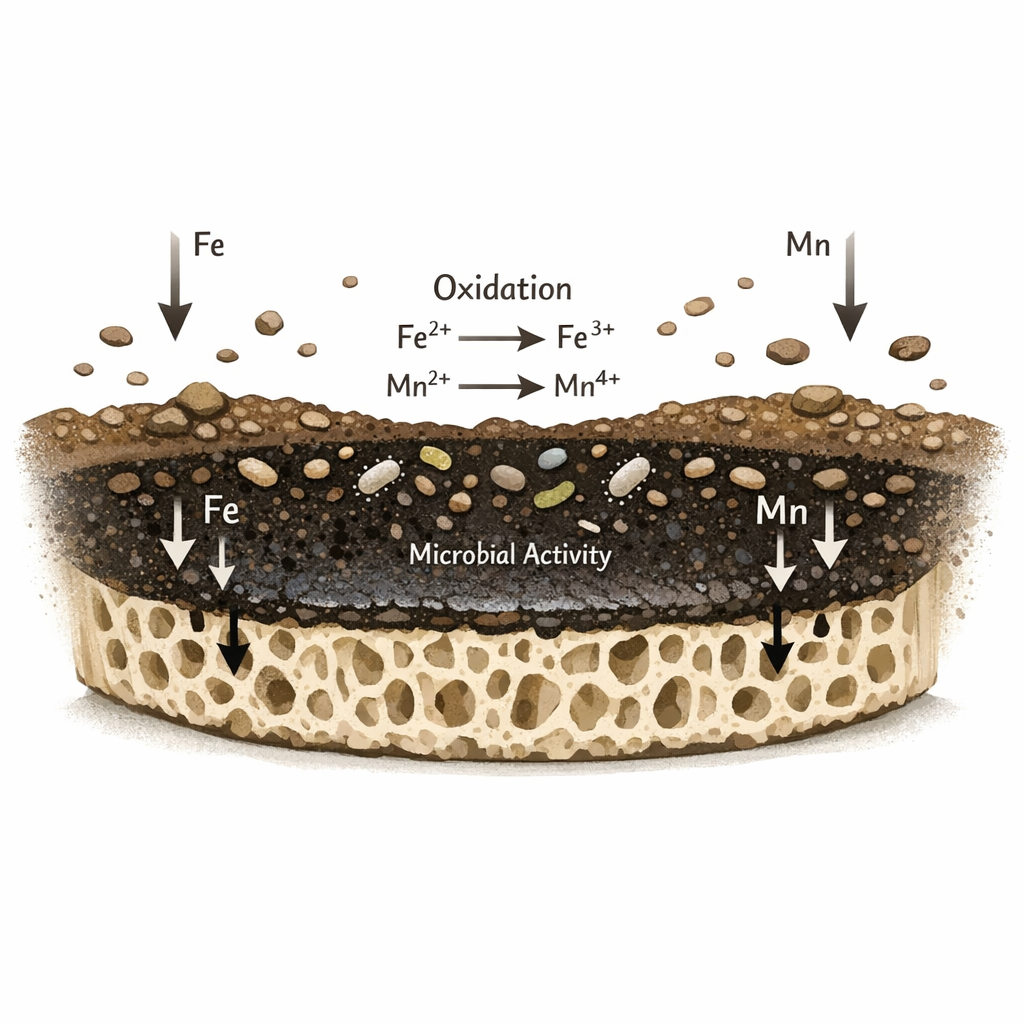
To uncover what these black deposits are made of, the team used a suite of non-destructive or minimally invasive techniques commonly applied in heritage science. Scanning electron microscopy showed that the underlying bone has a highly porous structure, the result of organic components decaying over centuries and leaving a mineral framework full of holes. Laser confocal images confirmed that the blackened areas are relatively flat films across this pitted surface. Elemental analyses, using both energy-dispersive X-ray spectroscopy and X-ray fluorescence, revealed that the base bone is dominated by calcium and phosphorus, as expected for bone, but that the black patches contain extra iron and manganese. These two metals were concentrated in the dark areas and largely absent from the lighter, cleaner-looking bone.
How the soil paints the shells
The surrounding soils at Taijiasi are naturally rich in iron and manganese and are neutral to slightly alkaline. In such conditions, these metals readily form oxides—rust-like minerals—that can be moved by groundwater. Micro-X-ray fluorescence maps showed that manganese in particular is strongly enriched where the shells look black, closely matching the visible stains. X-ray photoelectron spectroscopy, which probes how atoms are bonded, indicated that the iron is mainly in a trivalent form and the manganese in a higher oxidation state typical of stable oxides. The authors suggest that, over time, colloidal particles of iron and manganese oxides from the soil migrated onto the open, porous plastron surfaces, where they stuck, interacted with decaying organic matter and humic substances, and built up into a thin, dark film. Microbes that specialize in oxidizing these metals likely helped drive the chemical changes, even though specific organisms were not directly identified in this study.
What this means for saving the past
By showing that the black discoloration comes mainly from soil-borne iron and manganese rather than from ancient burning, the study changes how conservators should think about these objects. The dark films are not authentic traces of ritual use, but later products of burial chemistry and microbial activity. That means they can potentially be managed or reduced through careful treatments that limit further metal deposition and corrosion, such as desalination or targeted measures against iron and manganese oxides. Just as important, the findings provide a model for similar discoloration seen on oracle bones elsewhere in the region. In simple terms, the shells have not been "burned black" by their makers, but slowly stained by the very earth that kept them hidden—and preserved—for more than three millennia.
Citation: Yang, J., Gong, D., Jin, P. et al. Analyzing the surface black discoloration of oracle plastrons from the Taijiasi Site, China. npj Herit. Sci. 14, 33 (2026). https://doi.org/10.1038/s40494-026-02307-y
Keywords: oracle bones, turtle plastrons, archaeological conservation, burial soil chemistry, manganese and iron staining