Clear Sky Science · en
Dynamic patterns and resilience of cave-air CO₂ under tourism interferences in the Lushan National Geopark, north China
Hidden worlds beneath our feet
Caves are more than stunning tourist attractions; they are living parts of Earth’s climate system. The air inside them stores and moves carbon dioxide (CO₂), the same gas driving global climate change. This study of Jiutian Cave in northern China asks a timely question: as more people visit show caves, what happens to the delicate balance of CO₂ underground, and how quickly can the cave recover once the crowds go home?
A special cave under scientific watch
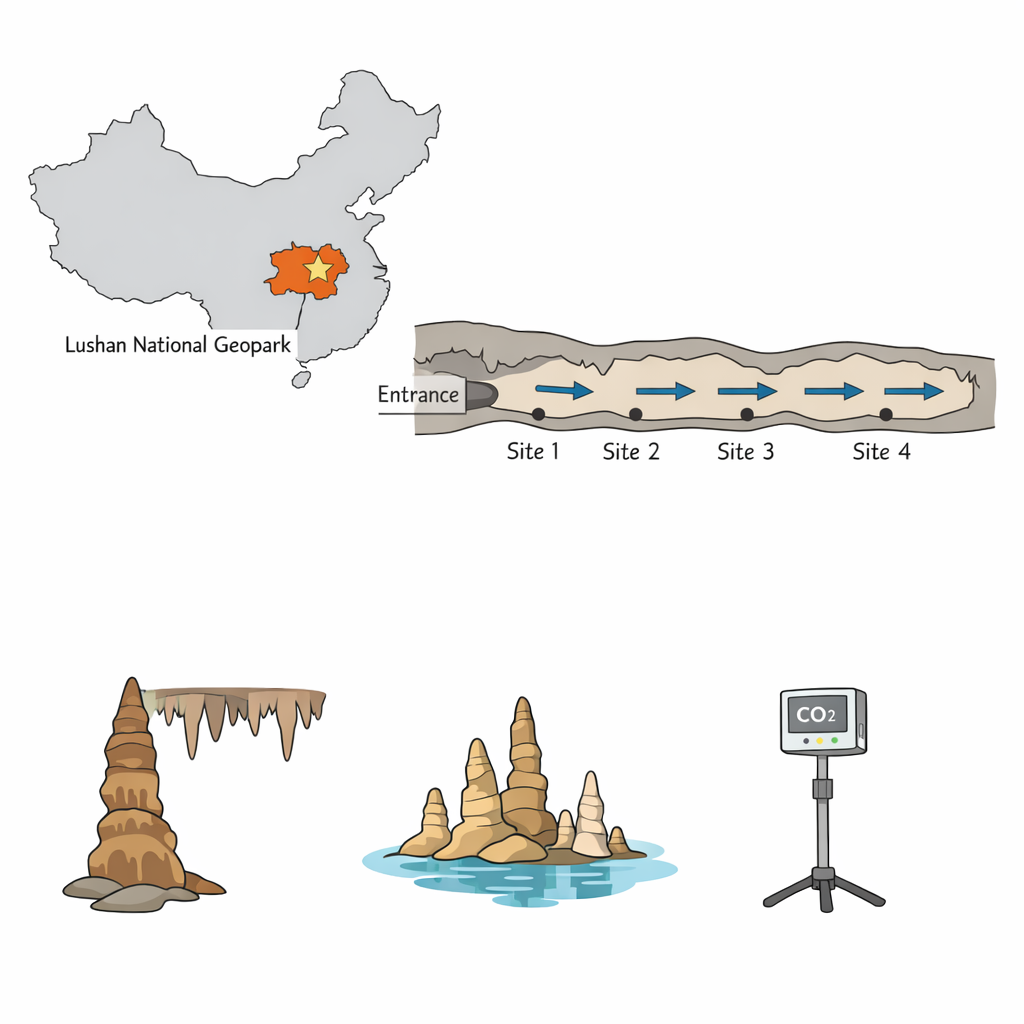
Jiutian Cave lies in Lushan National Geopark, in the temperate climate of northern China. It is a single long corridor, more than 600 meters in length, with one main entrance and tall chambers decorated with stalactites, stalagmites, and other mineral formations. The cave stays near 15 °C all year, while the outside air swings from icy winters to hot summers. Above the cave, a thin soil layer rich in plant roots and life produces CO₂ that seeps downward through cracks in the rock, slowly feeding the underground air. Because Jiutian is a popular tourist destination open year-round, it provides a natural laboratory to see how human visits disturb this underground carbon reservoir.
How scientists tracked the cave’s breath
From March 2023 to January 2025, the researchers installed instruments at four points along the tourist route, from the entrance to the deepest chamber. Every 10 minutes they recorded cave-air CO₂, temperature, and humidity. Outside, a weather station measured air conditions, rainfall, and soil properties, and sensors buried in the soil tracked soil CO₂. The team also obtained electronic ticket data for 2024 to know how many people entered the cave each day, especially during China’s major holidays such as Spring Festival, Labor Day, and National Day, when visitor numbers surge. With these high‑frequency measurements, they could see both slow seasonal changes and rapid jumps in CO₂ linked to tourism.
Natural ups and downs, plus tourist-driven spikes
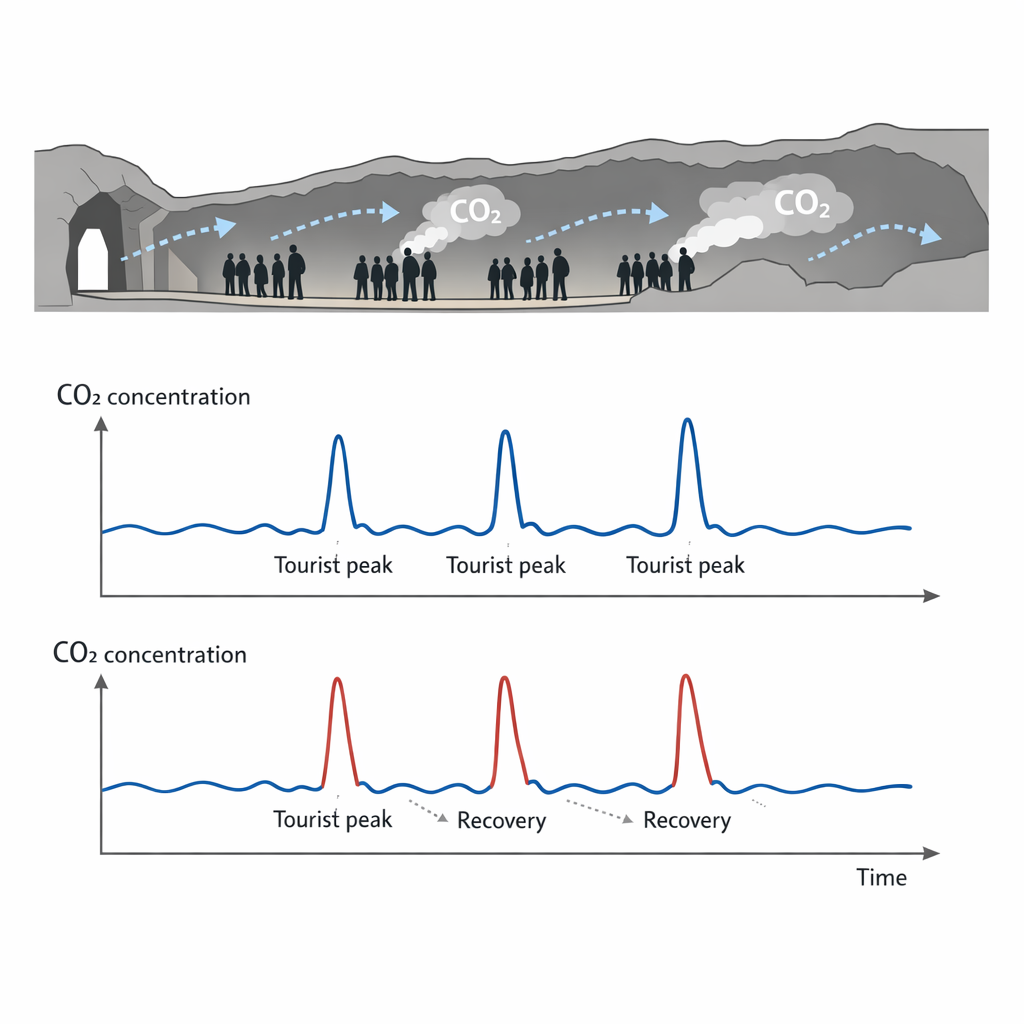
Over seasons, Jiutian Cave behaves like a lung connected to the landscape above. Soil CO₂ is higher in warm, wet months, and this pattern is echoed in the cave air, though with a delay of about two to three weeks as the gas migrates downward through the rock. Deeper in the cave, CO₂ levels are generally higher and more closely tied to soil CO₂, while near the entrance, outside winds and temperature swings disturb the signal. Yet on top of this natural rhythm, the team saw dramatic, short-lived spikes in CO₂ that lined up with holiday crowds. When tourists breathe in confined spaces, they release extra CO₂ that can push cave levels from a few thousand parts per million to above 20,000, far higher than outdoor air.
How long it takes the cave to bounce back
Once the holidays ended and the turnstiles quieted, the cave began to recover, but not all parts responded equally. Temperature and humidity rebounded quickly, often within a day, as cave walls absorbed heat and dripping water restored moisture. CO₂, however, lingered much longer. Near the entrance, concentrations might fall back close to normal within about a week. In the deeper chambers, where air circulation is weak and cool, dense air can stagnate, elevated CO₂ could persist for two to three weeks or more, and sometimes never fully returned to pre-holiday levels before the next disturbance. The study found that two things matter most: how many tourists come in a row (more than 100 people per day for at least four days in succession triggers strong CO₂ buildup), and whether the season favors natural ventilation. In winter and cool months, density differences between indoor and outdoor air create stronger airflow through the entrance, helping flush out CO₂; in summer, ventilation weakens and recovery slows.
Keeping caves healthy for science and visitors
For non-specialists, the key message is straightforward: cave air is surprisingly sensitive to our presence. Jiutian Cave’s CO₂ largely comes from the living soil above, but busy tourism periods add large pulses that the cave can only slowly remove. By limiting daily visitor numbers, spreading visits out in time, shortening stays in the deepest chambers, and favoring high-ventilation seasons like winter for peak tourism, managers can protect these fragile underground environments. Doing so preserves not only the beauty enjoyed by visitors but also the cave’s role as a natural archive of climate history and as a small, yet real, part of Earth’s carbon cycle.
Citation: Peng, S., Liu, W., Zhang, T. et al. Dynamic patterns and resilience of cave-air CO₂ under tourism interferences in the Lushan National Geopark, north China. npj Herit. Sci. 14, 31 (2026). https://doi.org/10.1038/s40494-026-02306-z
Keywords: cave tourism, carbon dioxide, karst caves, cave ventilation, environmental resilience