Clear Sky Science · en
Computer vision analysis of 之 knotting patterns in the Chinese calligraphy work The Orchid Pavilion
A New Look at an Ancient Masterpiece
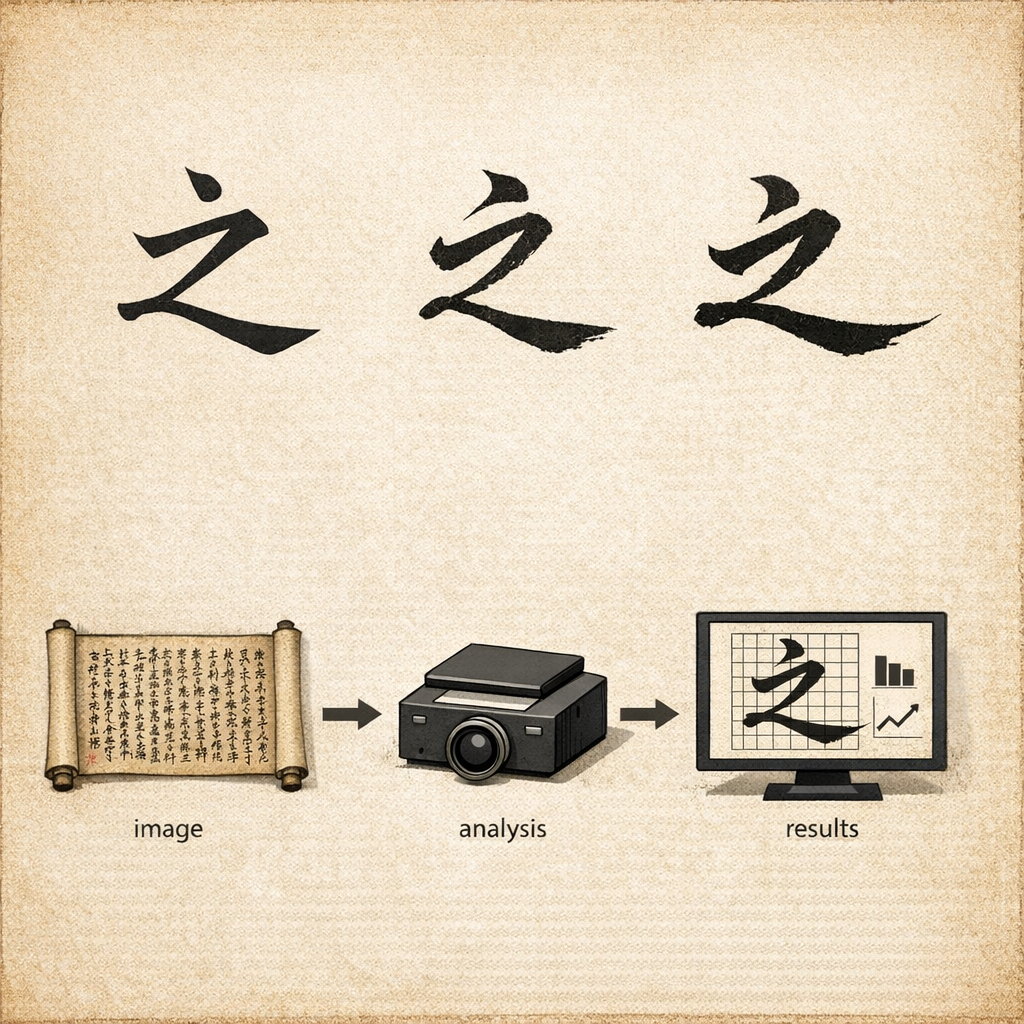
The Orchid Pavilion, a flowing essay written in graceful Chinese calligraphy more than 1,600 years ago, is often called the crown jewel of the art form. Yet until recently, its beauty was judged mainly by expert opinion and tradition. This paper shows how modern computer vision—technologies usually used in medical imaging or self-driving cars—can reveal hidden patterns in this masterpiece, offering fresh insight into how one tiny character, “之,” helps create a sense of harmony, rhythm, and emotional power on the page.
Why One Small Character Matters
The study focuses on just one character, “之,” which appears twenty times in the most faithful surviving copy of The Orchid Pavilion. Calligraphers have long praised how each “之” looks different yet still feels part of a unified whole, calling this the rule of “same character, different form.” Traditionally, such judgments were based on taste, training, and close visual inspection. By turning each instance of “之” into high-resolution digital images and measuring the shapes and spaces with a computer, the authors aim to translate these long‑held aesthetic ideas into numbers that can be tested, compared, and reused in future research.
Measuring Strokes, Space, and Complexity
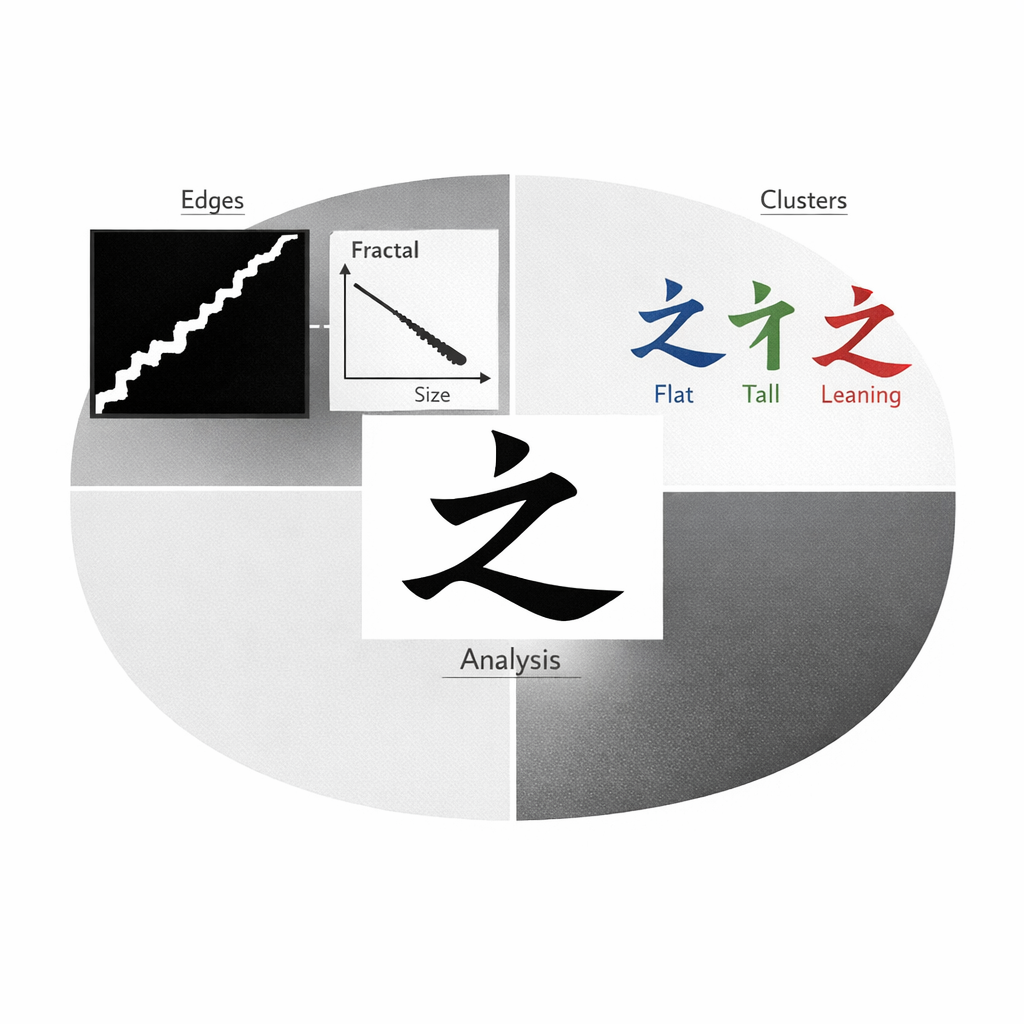
To do this, the researchers first isolated each “之” from the scroll and cleaned the background so that only black ink on white paper remained. They then used edge-detection algorithms to trace the outlines of the strokes and a mathematical tool called fractal analysis to describe how intricate those edges are. Fractals are commonly used to capture the roughness of coastlines or clouds; here they quantify how lively and varied the brushwork is. At the same time, the team measured how tall or wide each character is and how much of the surrounding rectangle is filled with ink versus left blank, treating white space not as “nothing” but as an active part of the design.
Patterns Hidden in Black and White
The numbers revealed several striking regularities. Across all twenty samples, the overall visual complexity of “之” stayed surprisingly stable, even though some characters were squat and wide while others were tall and slender. The ratio of black ink to white paper correlated strongly with this complexity: characters with more carefully balanced black and white areas tended to have richer, more intricate stroke patterns. The white areas generally outweighed the black, and the left side of the character turned out to be especially important in shaping how complex the whole figure appears. In other words, the feeling of elegance and energy that viewers sense is closely tied to how the artist distributes emptiness and fullness around the strokes.
Three Families of Forms
Next, the authors used a popular clustering technique, K‑means, to see whether the computer could automatically group the twenty “之” characters based on their proportions and black‑white balance. The algorithm divided them into three families. The first and most common type is low and broad, with an even spread of ink and space—visually calm yet firm. The second is taller and slimmer but still balanced, giving a lighter, rising feel. The third, which appears only once, leans and crowds its strokes, reflecting a place in the text where Wang Xizhi corrected his writing. This rare outlier illustrates the artist’s willingness to bend rules for expressive effect, while the two main families show his constant return to balance and clarity.
Bringing Numbers and Tradition Together
For non‑specialists, the main message is that the grace of The Orchid Pavilion is not mysterious magic, but a highly disciplined play of proportion, repetition, and variation that can now be described quantitatively. By proving that the classic idea of “same character, different form” has a measurable structure, the study argues against modern trends that celebrate deliberately “ugly” or chaotic writing detached from tradition. It also opens a path for museums, teachers, and technologists to preserve, search, and even digitally recreate calligraphy with the help of algorithms. In blending ancient brushwork with contemporary image analysis, this work shows how science can deepen, rather than replace, our appreciation of one of humanity’s oldest visual arts.
Citation: Li, L., Zhao, C. Computer vision analysis of 之 knotting patterns in the Chinese calligraphy work The Orchid Pavilion. npj Herit. Sci. 14, 39 (2026). https://doi.org/10.1038/s40494-026-02302-3
Keywords: Chinese calligraphy, computer vision, The Orchid Pavilion, digital heritage, fractal analysis