Clear Sky Science · en
Experimental study on mechanical behavior and bond-slip of historical Chinese rebars during 1912 to 1949
Why old concrete still matters today
Across many Chinese cities, early 20th‑century concrete buildings helped usher in modern life, blending Western engineering with local traditions. These structures are now treasured cultural heritage, but the steel bars hidden inside their concrete were made very differently from today’s reinforcing steel. To repair or strengthen these aging buildings safely, engineers first need to know how those historical steel bars actually behave when pulled or when they start to slip inside the surrounding concrete.
Hidden steel in landmark buildings
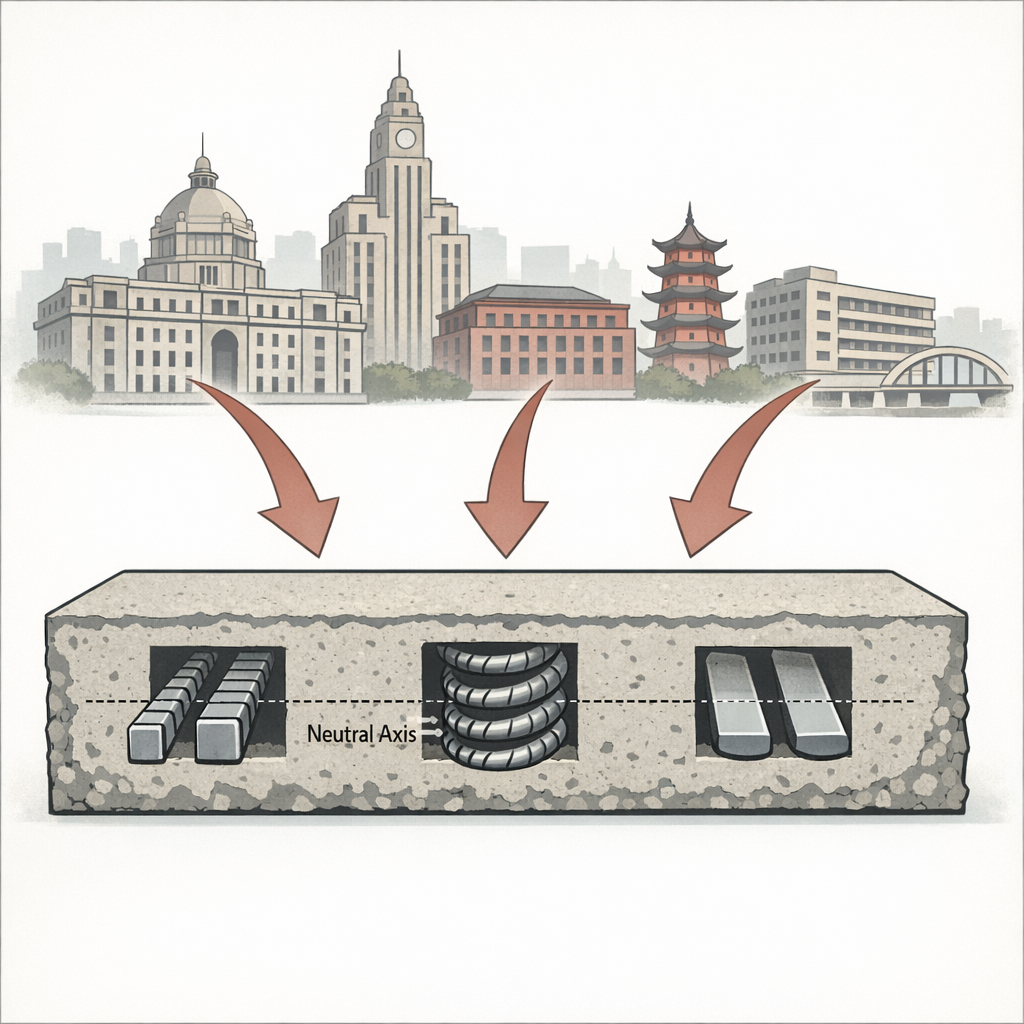
Between 1912 and 1949, builders in China used reinforced concrete in a wide range of important structures. The steel bars in these buildings came in several shapes: square bars with straight ribs, spiral (helical) bars, and flat, oblate bars. Unlike modern rebars, which look fairly uniform, these older bars have very different surface patterns and sizes. The authors collected six representative types of historical rebars directly from real buildings of that era, along with concrete made according to period recipes, to capture how the “original” materials truly behave rather than relying on modern substitutes.
Putting century‑old steel to the test
To probe their strength, the team first carried out tensile tests, which simply stretch a metal bar until it yields and finally breaks. They measured how much each bar could carry, how far it stretched, and how its cross‑section thinned before failure. They found that spiral bars generally reached higher tensile strength than square bars but were less ductile, meaning they could not stretch as much before breaking. Smaller‑sized bars tended to elongate more and showed more pronounced “necking,” where the metal pinches in just before fracture. Compared with modern HRB400 rebars commonly used today, these historical steels were weaker overall and had very different stretching behavior, which is crucial when predicting how an old beam or column will react under load.
How steel grips concrete
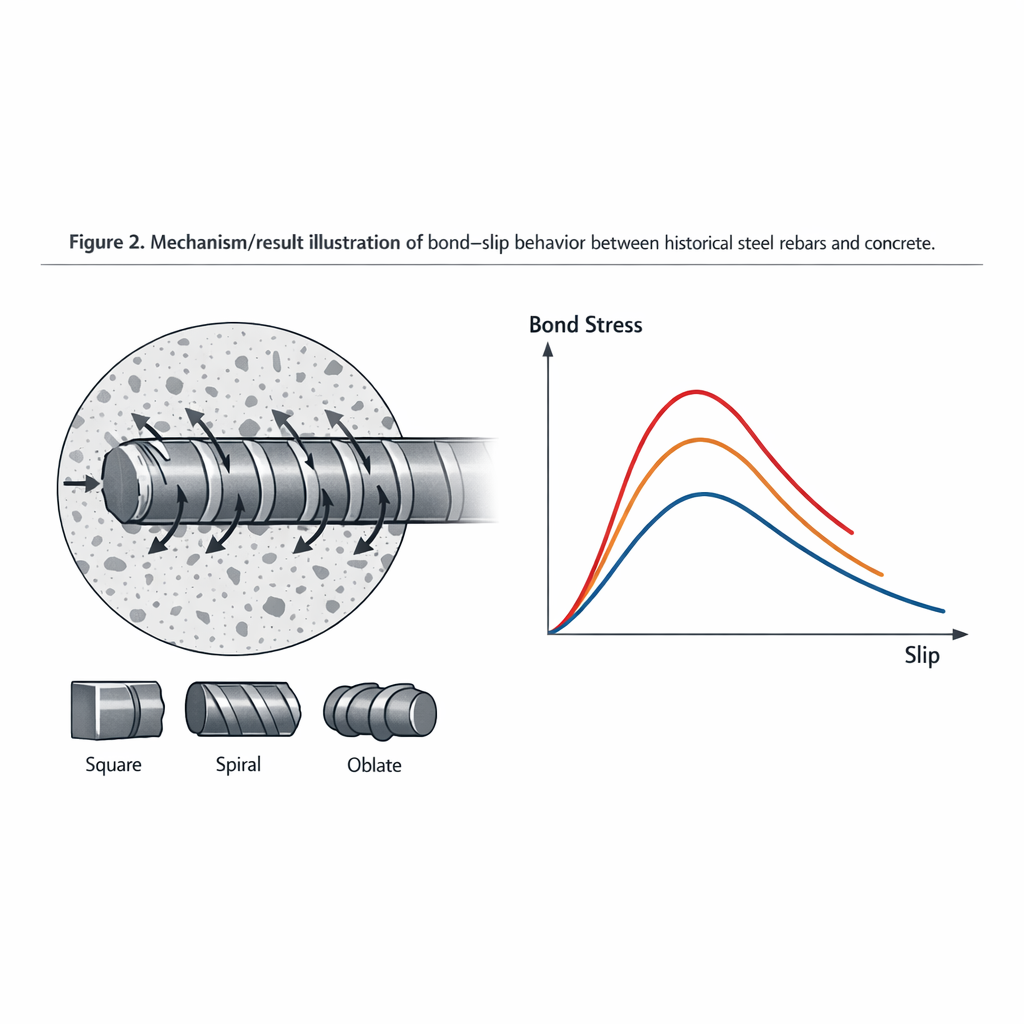
Strength alone does not keep a structure safe; the way steel and concrete cling to each other is just as important. The authors studied this “bond‑slip” behavior using pull‑out tests, where a short length of rebar is embedded in a concrete block and then pulled while the relative movement, or slip, is recorded. They varied how fast the bar was pulled—slow, medium, and fast—and monitored how the bonding stress changed with slip. To compare very different rib patterns, they introduced a single index called the relative rib area ratio, which captures how much ribbed surface is available for the concrete to lock onto. In general, bars with larger effective rib areas, such as spiral and oblate types, developed higher bond strength. Increasing the pulling rate raised the maximum bond strength slightly—by up to about 8%—but also led to quicker and sometimes more abrupt failures, especially because the surrounding historical concrete is relatively weak.
Linking surface shape to grip
By fitting smooth curves to their test data, the researchers created “typical” bond‑slip curves for each of the six rebar types. These curves describe how the bond stress rises, peaks, and then falls as slip grows, and they matched the measurements very closely. The team then proposed a simplified analytical model that explains bond mostly through mechanical interlocking: the way concrete keys into the bar’s ribs. The model ties bond strength to both the concrete’s compressive strength and the rib area ratio, using a single interlocking factor calibrated from experiments. When they compared the model’s predictions with test results, the average difference in bond strength was under 7%, showing that this compact description captures the essential behavior of historical steel–concrete interfaces.
What the metal’s inner structure reveals
The study also looked at the microstructure of the steel under a microscope. All the historical bars lacked obvious harmful inclusions, but they differed in the balance between two main phases: soft, ductile ferrite and harder, stronger pearlite. Spiral and oblate bars, especially one spiral type, contained much more pearlite than the square bars. This helps explain why those bars were stronger but less able to deform smoothly, and why they sometimes failed without a clear yielding plateau. The authors suggest that these differences likely arise from variations in heat treatment—particularly cooling rates during annealing—rather than from a completely different rolling process.
What this means for saving old buildings
For a non‑specialist, the key message is that the steel skeleton inside China’s early reinforced concrete buildings does not behave like modern reinforcing steel. Its shapes, surface patterns, and internal metal structure all change how it bonds to concrete and how it fails. The experimental data and the new simplified bond‑slip model give conservation engineers realistic numbers and design tools tailored to the 1912–1949 building stock. Using these, they can run more accurate simulations and design repairs that respect both safety and heritage value, helping historic concrete landmarks survive another century.
Citation: Lin, B., Chun, Q. Experimental study on mechanical behavior and bond-slip of historical Chinese rebars during 1912 to 1949. npj Herit. Sci. 14, 23 (2026). https://doi.org/10.1038/s40494-026-02300-5
Keywords: historical reinforced concrete, steel rebar, bond-slip behavior, heritage conservation, structural engineering