Clear Sky Science · en
Characterization and Identification of the lacquered gauze excavated from Lianying Han Tomb in China
A Hidden Treasure from an Ancient General’s Tomb
More than 2,000 years ago, high-ranking officials in China’s Han Dynasty wore headgear made from a remarkable material: gauze stiffened and protected with natural tree lacquer. In a recently excavated tomb belonging to a military general named Fan Xuqi, archaeologists uncovered rare fragments of this lacquered gauze. By carefully analyzing these fragile scraps, scientists can now reconstruct how ancient craftspeople turned plant fibers and tree sap into a lightweight, waterproof, and durable fabric—knowledge that also helps today’s conservators protect these delicate artifacts for the future.
An Ancient Cemetery and a Rare Find
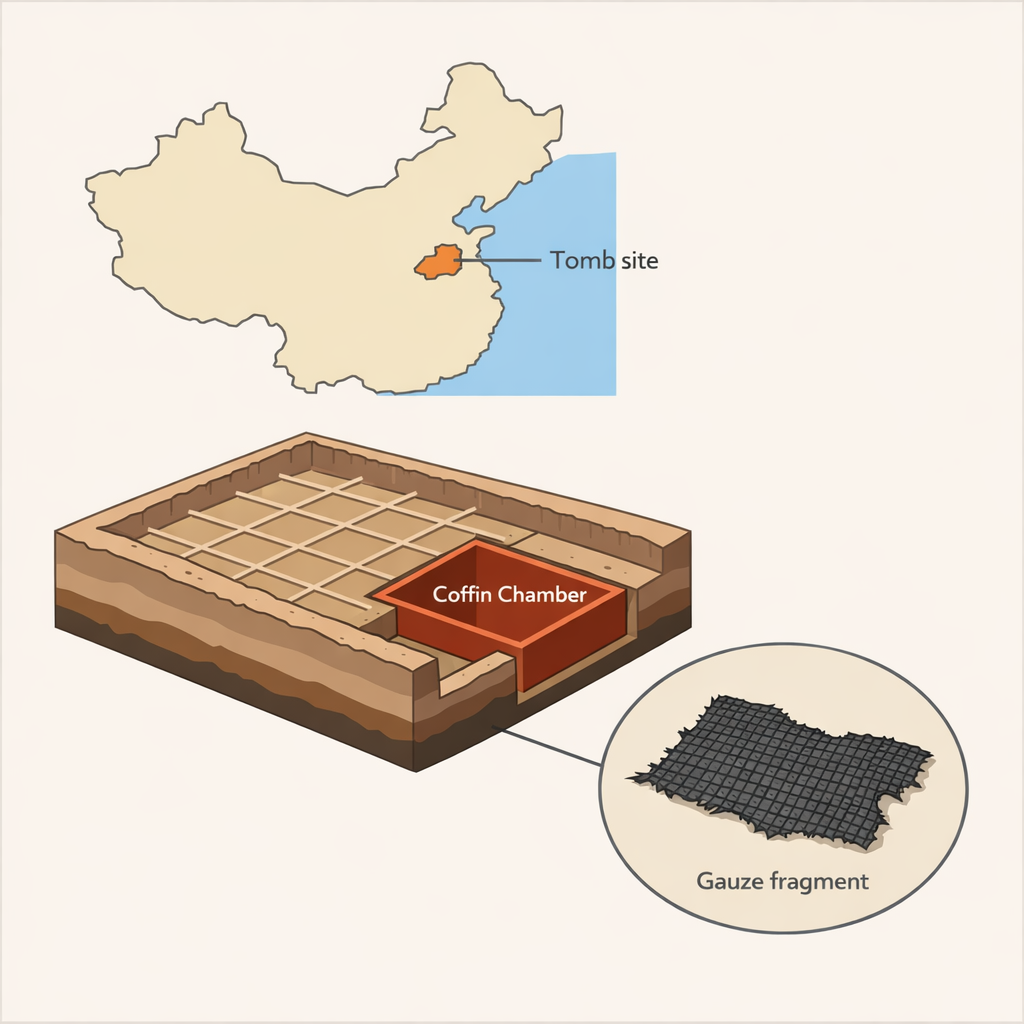
The study focuses on Tomb M59 in the Lianying Han cemetery near Yangzhou, Jiangsu Province, a large burial ground associated with the powerful King of Guangling. Inside a richly decorated, red inner coffin painted with cloud-and-dragon designs, excavators found weapons, fine lacquerware, jade, and—most unusually—about 500 square centimeters of lacquered gauze. One piece even resembled an ear flap with a hole for tying a cord, suggesting it was once part of a headgear worn by military officers. Written records and images from the period show such lacquered gauze hats as symbols of aristocratic rank, yet very few physical examples survive because the material decays easily over time.
How Lacquered Gauze Was Meant to Work
Lacquered gauze is essentially a textile reinforced with natural lacquer tapped from East Asian lacquer trees. This raw lacquer is a complex natural polymer rich in a compound called urushiol, which hardens into a tough, glossy film with excellent waterproof and anti-corrosion properties. Ancient artisans applied it to loosely woven silk or plant-fiber fabrics to create a material that was breathable yet strong, capable of holding a three-dimensional shape while standing up to sweat, rain, and daily wear. In the Han Dynasty, such craftsmanship represented a sophisticated blend of textile technology and chemistry, long before those sciences had names.
Peering into Fibers and Films
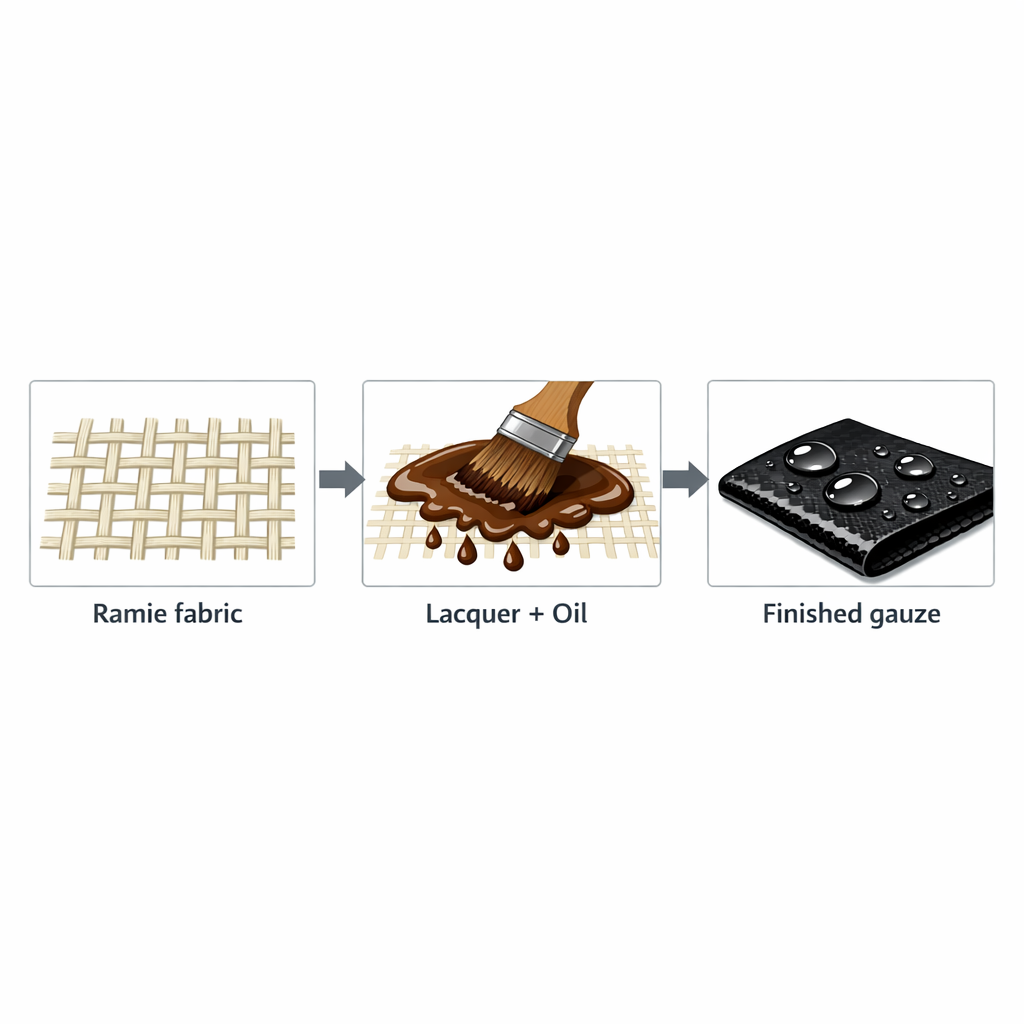
To understand exactly how the Lianying gauze was made, the researchers combined several modern techniques. High-powered optical microscopes revealed the overall mesh structure: evenly spaced threads about 0.3 millimeters thick, woven in groups that cross in two directions to form adjustable diamond-shaped openings. This unusual, deformable weave would have allowed a hat or headcover to fit snugly yet flexibly. Scanning electron microscopy then zoomed in on individual fibers, comparing them to modern reference samples. The fibers from the ancient gauze turned out to match ramie, a strong, breathable bast fiber from a nettle-like plant that was widely used in ancient China. Unlike silk, ramie gave the base fabric extra toughness and stiffness, making it ideal for a lacquered support.
Chemical Fingerprints of Trees and Plants
Next, the team used infrared spectroscopy to probe the outer film and a powerful technique called thermally assisted pyrolysis–gas chromatography–mass spectrometry to break down minute samples into their molecular components. The infrared spectra of the film closely resembled that of modern raw lacquer, confirming that the coating was indeed traditional tree lacquer. The more detailed pyrolysis analysis detected characteristic fragments of urushiol, along with breakdown products of cellulose and lignin, the building blocks of plant fibers—further evidence for a ramie base coated in genuine lacquer. Importantly, the scientists also found chemical markers of a drying oil. By comparing the ratios of different fatty acids, they identified this oil as linseed oil, which would have been mixed into the lacquer to make the film glossier, more flexible, and more adhesive.
What This Means for History and Preservation
Taken together, the results show that the Lianying lacquered gauze was crafted from ramie cloth coated with raw lacquer modified by linseed oil, using a special adjustable mesh weave. For historians, this clarifies how a prestigious piece of Han court attire was engineered from natural materials, marrying plant fibers, tree sap, and vegetable oil in a smart design. For conservators, it supplies a recipe of sorts: knowing the exact fibers, coatings, and additives makes it possible to stabilize surviving fragments and even reconstruct missing parts with compatible materials. In essence, by decoding a few dark, brittle scraps from a general’s tomb, researchers have brought back to life the ingenuity behind one of ancient China’s most refined textile technologies.
Citation: zhang, Y., Li, D., Wang, Z. et al. Characterization and Identification of the lacquered gauze excavated from Lianying Han Tomb in China. npj Herit. Sci. 14, 27 (2026). https://doi.org/10.1038/s40494-026-02298-w
Keywords: lacquered gauze, Han Dynasty, ramie fabric, archaeological conservation, ancient Chinese textiles