Clear Sky Science · en
The East Asian transmission of Southern Song Zen Buddhist painting base on compositional perspective
Why these ancient paintings still matter
Across museums from Shanghai to Tokyo, spare ink paintings of monks and poets sit quietly on the walls: a lone figure near the bottom, a sea of empty paper above, and a few lines of calligraphy drifting overhead. This study asks a modern question about these centuries‑old works: can computers help us see how ideas about Zen Buddhism traveled from Southern Song China to medieval Japan? By treating each painting like a field of measurable visual information, the authors show how a distinctive way of arranging figures and empty space was passed on, adapted, and made uniquely Japanese.
A new way to read old scrolls
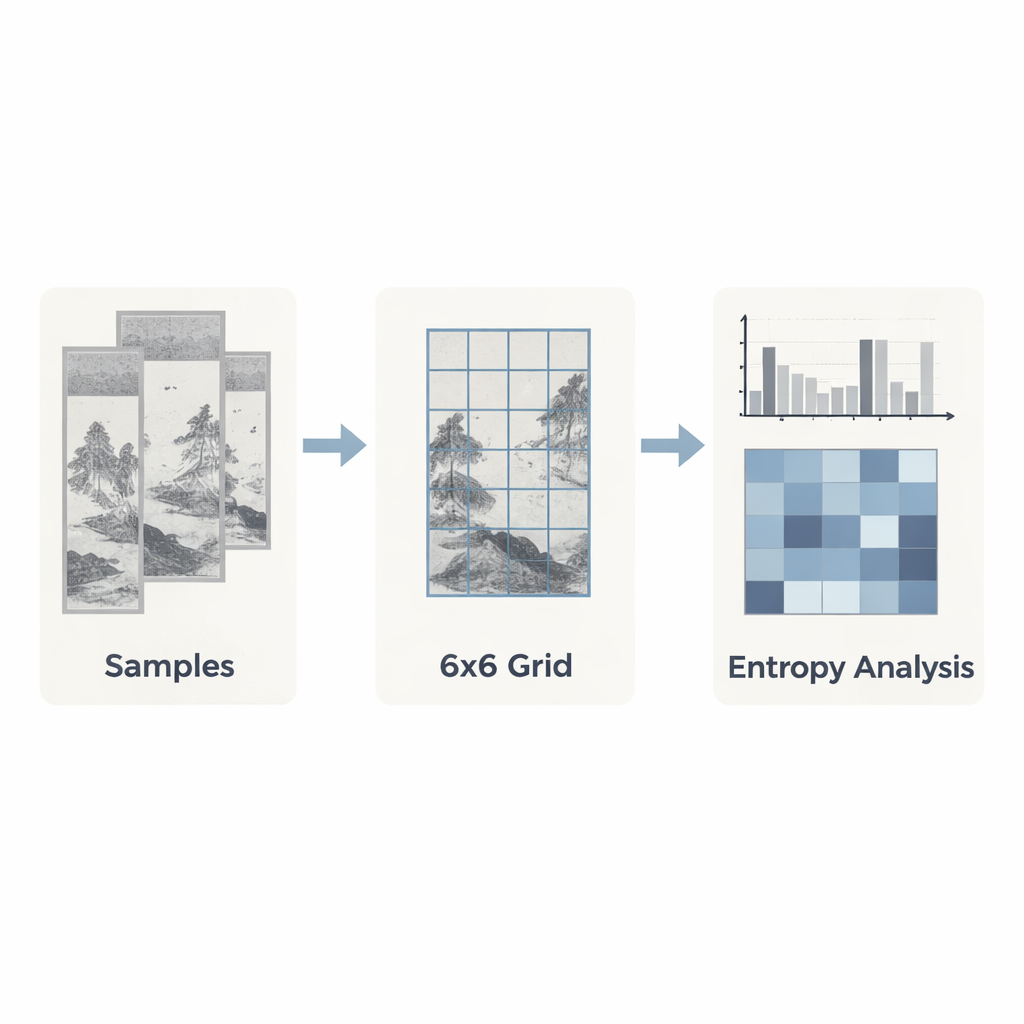
Instead of relying only on expert opinion, the researchers used a computer‑based method borrowed from information theory. They gathered high‑quality digital images of 49 vertical hanging‑scroll figure paintings: works by the Chinese Zen masters Liang Kai and Muqi, by the Japanese monk‑painter Sesshū Tōyō, and, for contrast, by the Southern Song court painter Liu Songnian. After carefully brightening and cleaning the images, they sliced each one into a simple 6×6 grid and calculated how visually “busy” each block was. The busier the block—the more ink strokes, contrasts, and details—the higher its “entropy,” or information content.
Finding the hidden pattern in Zen art
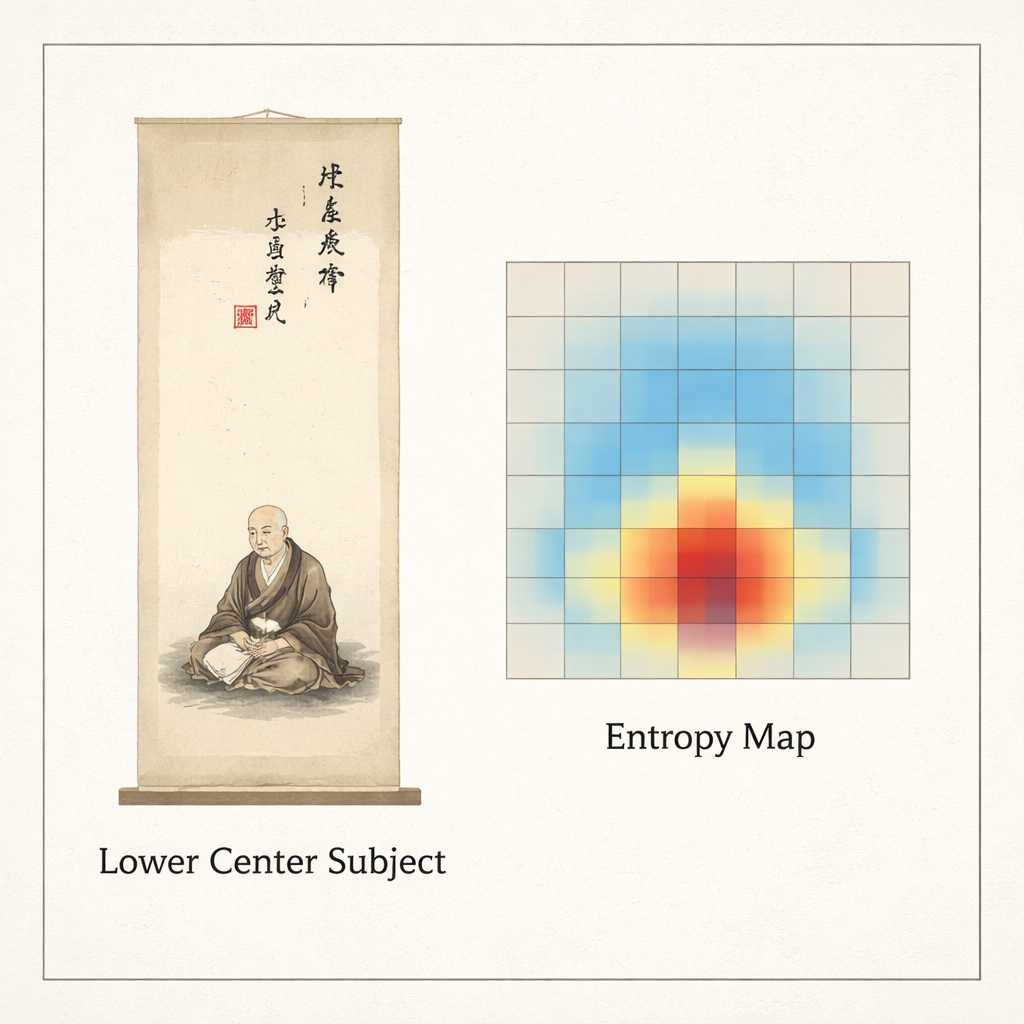
The entropy maps revealed a strikingly consistent pattern in Zen figure paintings. For Liang Kai, Muqi, and Sesshū alike, the highest‑information blocks cluster in the lower middle of the scroll, especially around a position labeled V(3,5). In everyday terms, the main figure tends to sit slightly below the center, while the upper half of the painting is left relatively empty except for a bold inscription. This “lowered center of gravity” contrasts sharply with more formal court paintings, where attention is pulled upward toward elaborate architecture, crowded groups, and detailed scenery. In Zen works, the calm blank space above the figure visually echoes core ideas of emptiness and direct insight.
China’s Zen vision, Japan’s Zen voice
The numbers also help tease apart what Sesshū borrowed and what he changed. Like Liang Kai, he favored swift, simplified brushwork that captures a figure’s energy with only a few strokes. Like Muqi, he used empty backgrounds and subtle ink tones to suggest limitless space and a world that cannot be fully grasped in words. Yet Sesshū’s overall information patterns are more uneven: some regions in his paintings are dense with narrative detail—plants, robes, gestures—set against broad, quiet voids. This unevenness reflects a Japanese sensibility shaped by wabi‑sabi austerity and the warrior ethos of bushidō, blending Chinese Zen spontaneity with a taste for stark landscapes, seasonal loneliness, and emotional restraint.
What makes Zen painting different from court art
The comparison with Liu Songnian’s courtly religious scenes sharpens the contrast. His paintings show higher information levels almost everywhere, with carefully described rocks, buildings, furniture, and attendants. Entropy is spread across the scroll, and focal points sit higher up. These works aim to teach moral and spiritual lessons through richly staged settings. Zen paintings do something else: they strip away most of the world so that a single monk, a laughing sage, or even a comic figure with a big belly becomes a direct pointer to inner awareness. The computer’s measurements of where detail collects and where it thins out capture this difference between ordered description and purposeful understatement.
What the study means for non‑specialists
For a lay viewer, the takeaway is that the “look” of Zen painting—figures low on the paper, huge empty areas, and sudden bursts of inky energy—is not just a matter of taste; it is a shared visual language that carried Zen ideas across borders. This study shows that a machine can detect that language and even measure how it was reshaped when it moved from Chinese monasteries to Japanese temples. By turning brushstrokes and blank space into analyzable data, the authors offer a new, repeatable way to study how spiritual and artistic traditions travel, change, and endure, while leaving intact the quiet mystery that keeps these paintings compelling today.
Citation: Fu, R., Li, J. & Fan, R. The East Asian transmission of Southern Song Zen Buddhist painting base on compositional perspective. npj Herit. Sci. 14, 120 (2026). https://doi.org/10.1038/s40494-026-02297-x
Keywords: Zen painting, ink art, art and AI, East Asian Buddhism, Sesshu Toyo