Clear Sky Science · en
Cooling high-density historic districts with strategic greening in the “port-opening area” of Shantou city
Why cooler old streets matter
Many of the world’s favorite historic districts are becoming uncomfortably hot in summer, especially as cities grow denser and heat waves intensify. In Shantou, a coastal city in southern China, a famous “port-opening” quarter filled with ornate arcade buildings now faces dangerous afternoon heat that discourages visitors and strains the aging structures themselves. This study asks a deceptively simple question with global relevance: how much greenery, and in what form, is needed to cool such tightly packed heritage streets without damaging their character or blocking treasured views?
An old port under modern heat
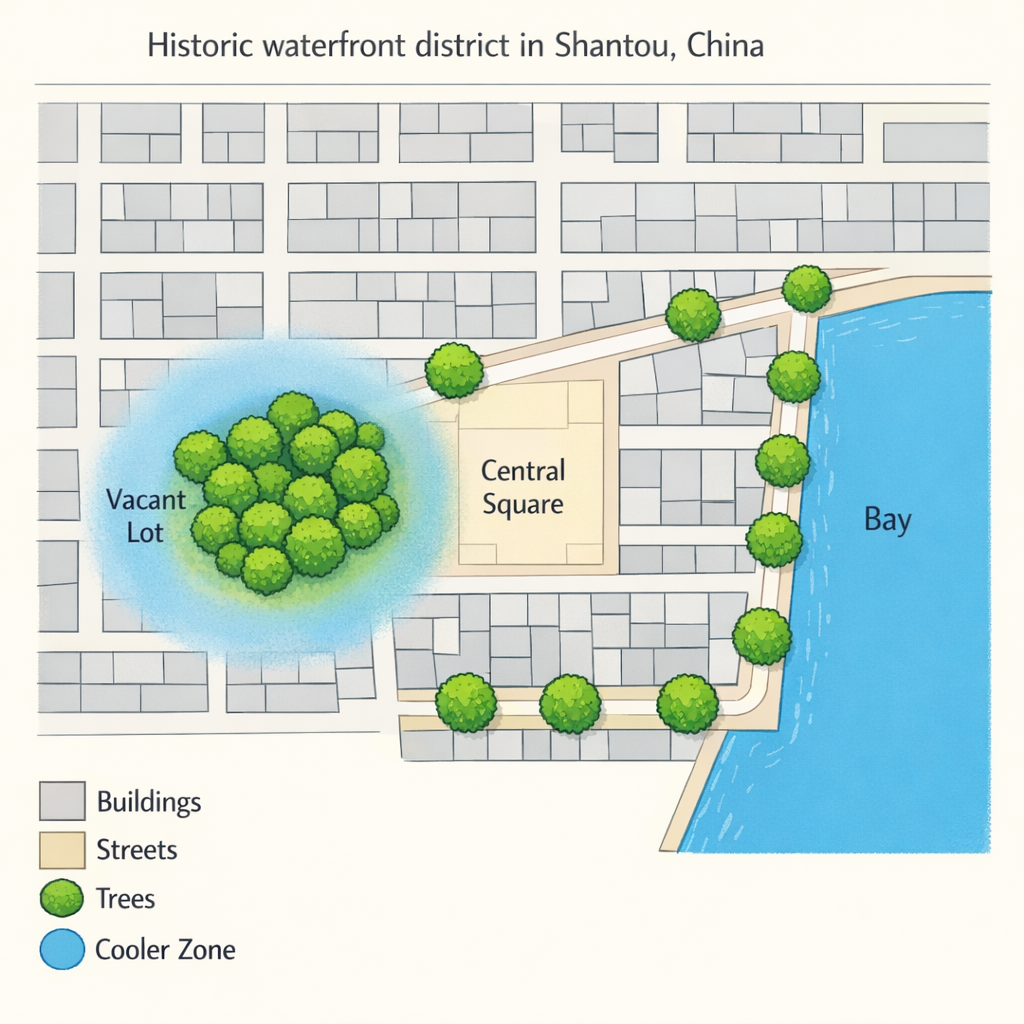
The researchers focus on a compact 230-by-270-meter area around Zhongshan Pavilion in Shantou’s port-opening district, a maze of mid-rise arcade buildings and narrow streets that has grown steadily since the 19th century. Once a symbol of overseas trade and local pride, the area is now a busy tourist destination with a pronounced urban heat island effect. Ten years of weather records show typical summer highs around 32–33 °C, but what people actually feel at street level can be much hotter, especially when sunshine, humidity, and weak breezes combine in paved spaces. Because heritage rules tightly limit new construction and major alterations, solutions must work within an already crowded urban fabric.
Measuring heat where people walk
To understand how oppressive the summer climate has become, the team combined field measurements with advanced computer simulations. They placed instruments at four locations: two key streets with different orientations, a street intersection, and the central square. Over a full summer day, they recorded air temperature, humidity, and wind speed, then fed these data into ENVI-met, a widely used software that simulates how buildings, paving, sun, wind, and vegetation interact. Instead of relying on air temperature alone, they used a comfort index called Physiological Equivalent Temperature, which blends weather conditions with typical clothing and activity to estimate how hot it actually feels to a person.
Pinpointing the worst heat
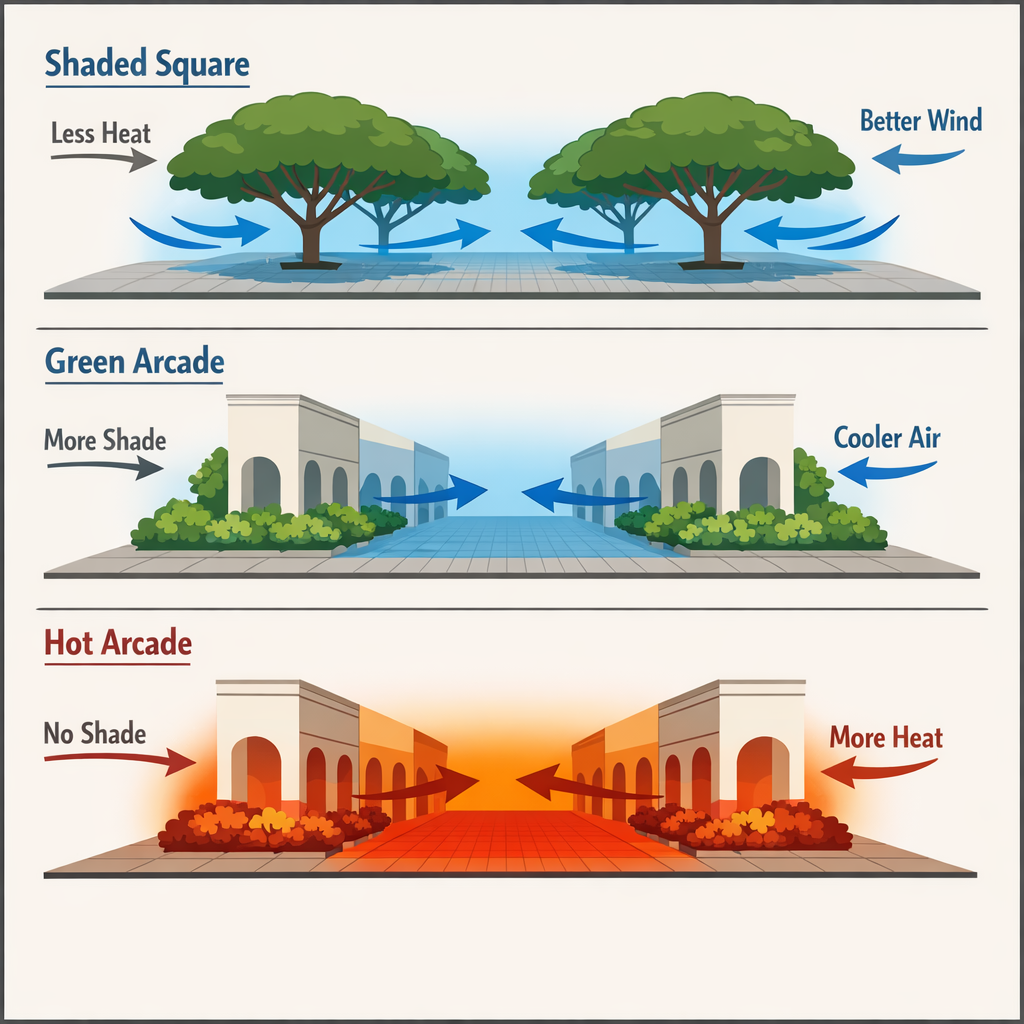
The results paint a stark picture. Across the district, the most dangerous period is between 2:00 and 3:00 p.m., when strong sun, warm air, and sluggish winds combine. During this window, the comfort index everywhere in the study area exceeds 43 °C—classified as “very hot” and potentially unsafe for prolonged outdoor activity. Open paved spaces such as the central square heat up the most, while narrow streets behave differently depending on their orientation and the ratio of building height to street width. Streets with taller buildings on both sides cast more shade and stay cooler, but can trap air if poorly aligned with the prevailing wind. In Shantou’s climate, direct sunlight and wind speed together turned out to be the main levers that determine how people feel outdoors.
Testing trees and shrubs as natural coolers
With the hot spots identified, the researchers tested greening strategies that could realistically fit within conservation rules. In a vacant area west of the central square, they modeled three “patchy” tree layouts with 25, 50, and 75 percent canopy coverage, all using umbrella-shaped trees about seven meters tall. In the streets, where views of historic facades and fire access are crucial, they simulated two “linear” schemes that add 1-meter and 2-meter shrubs along the sides, keeping plant height below eye level and within tight width limits. For each design, they re-ran the ENVI-met model to see how much the comfort index dropped, not only under the trees but also in surrounding streets.
How much green gives the best payoff
The most heavily planted tree scheme, with roughly three-quarters of the vacant lot shaded by canopy, delivered the strongest cooling. During the worst afternoon hours, it lowered the comfort index by up to about 11 °C inside the greened space and meaningfully cooled nearby streets as well, creating a “cool island spillover” that reached pedestrians who never set foot under the trees. However, the gains did not rise in a straight line: going from 50 to 75 percent coverage added less benefit per extra bit of greenery and sometimes slightly worsened comfort in small pockets by blocking breezes. The shrub belts along narrow streets were more modest but precisely targeted, trimming perceived heat by as much as about 3–4 °C in zones where people walk, especially when shrubs were 2 meters high. Overall, dense tree clusters in open spaces offered broad-area relief, while low shrubs along façades provided micro-scale shade without spoiling heritage views.
Practical guidance for saving hot heritage streets
To make their findings useful for planners, the authors calculated simple “value for money” measures: how many degrees of cooling, and how much area of improved comfort, result from each percentage point of added greenery. They conclude that for squares and vacant lots in similar subtropical historic districts, tree canopies covering about 50–75 percent of the space strike the best balance between strong cooling and healthy air flow. In cramped streets where full-grown trees do not fit, narrow belts of 1–2 meter shrubs can still make a noticeable difference at pedestrian level. Rather than treating greening as decoration, the study shows it can be planned like infrastructure: carefully sized, placed, and quantified to protect both people and heritage in an era of rising urban heat.
Citation: Liu, W., Mai, J., Yuan, S. et al. Cooling high-density historic districts with strategic greening in the “port-opening area” of Shantou city. npj Herit. Sci. 14, 107 (2026). https://doi.org/10.1038/s40494-025-02290-w
Keywords: urban heat, historic districts, urban greening, thermal comfort, Shantou China