Clear Sky Science · en
The acid attack (1990) on Rembrandt’s The Night Watch (1642). Reassessing the painting’s condition through a multimodal analytical approach
A Famous Painting Under Attack
Rembrandt’s The Night Watch is one of the world’s most celebrated paintings, drawing millions of visitors to the Rijksmuseum in Amsterdam. Few realise that in 1990 it was doused with concentrated sulphuric acid during an act of vandalism. At the time, experts believed that only the clear varnish on top had suffered, and that the paint beneath had escaped harm. This article revisits that assumption using modern scientific tools, asking a simple but gripping question: did the acid secretly wound Rembrandt’s masterpiece, and if so, what does that mean for its future care?
The Day Acid Hit The Night Watch
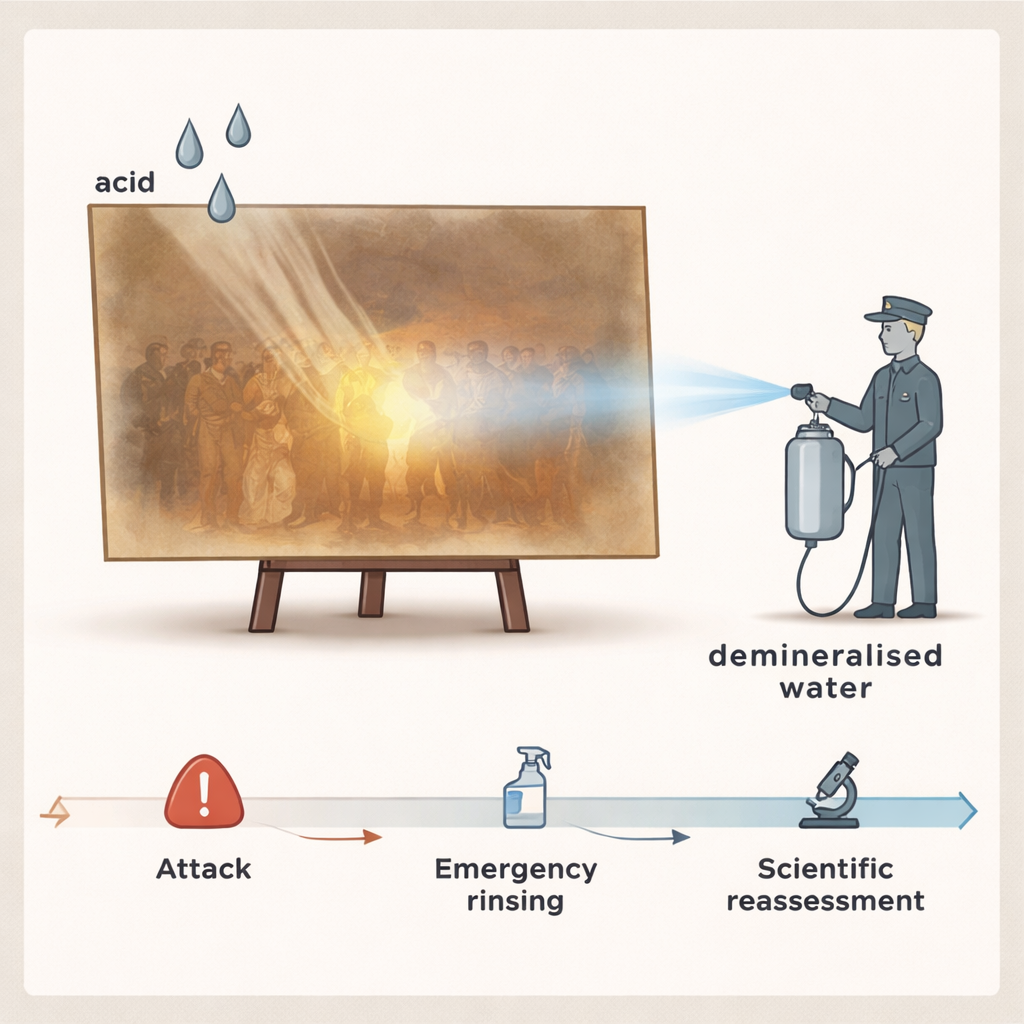
On an April morning in 1990, an attacker sprayed sulphuric acid across a swath of The Night Watch, leaving streaming trails over the faces and armour of several figures. Thanks to prior emergency planning, guards and conservators reacted within minutes, misting the affected area with roughly 60 litres of demineralised water to dilute and wash away the acid. Because the painting had a thick, oil-containing varnish and a wax–resin lining that made the surface water-repellent, the immediate visual damage appeared surprisingly limited. Within weeks, after drying and local varnish repairs, the painting was back on display and the prevailing view was that the paint itself had remained safe.
Why Scientists Decided To Look Again
Three decades later, the Rijksmuseum launched “Operation Night Watch,” a major research and conservation campaign that brought together historians, conservators and physicists. This project provided a rare chance to examine the acid-hit area with cutting-edge imaging methods that were unavailable in 1990. Researchers wanted to know whether the sulphuric acid had reacted with key painting materials such as lead white pigment and chalk, forming new compounds that might only reveal themselves slowly over time. Such hidden changes could make the paint weaker, chalkier or more difficult to treat when the thick, old varnish is finally removed.
Seeing The Invisible Damage
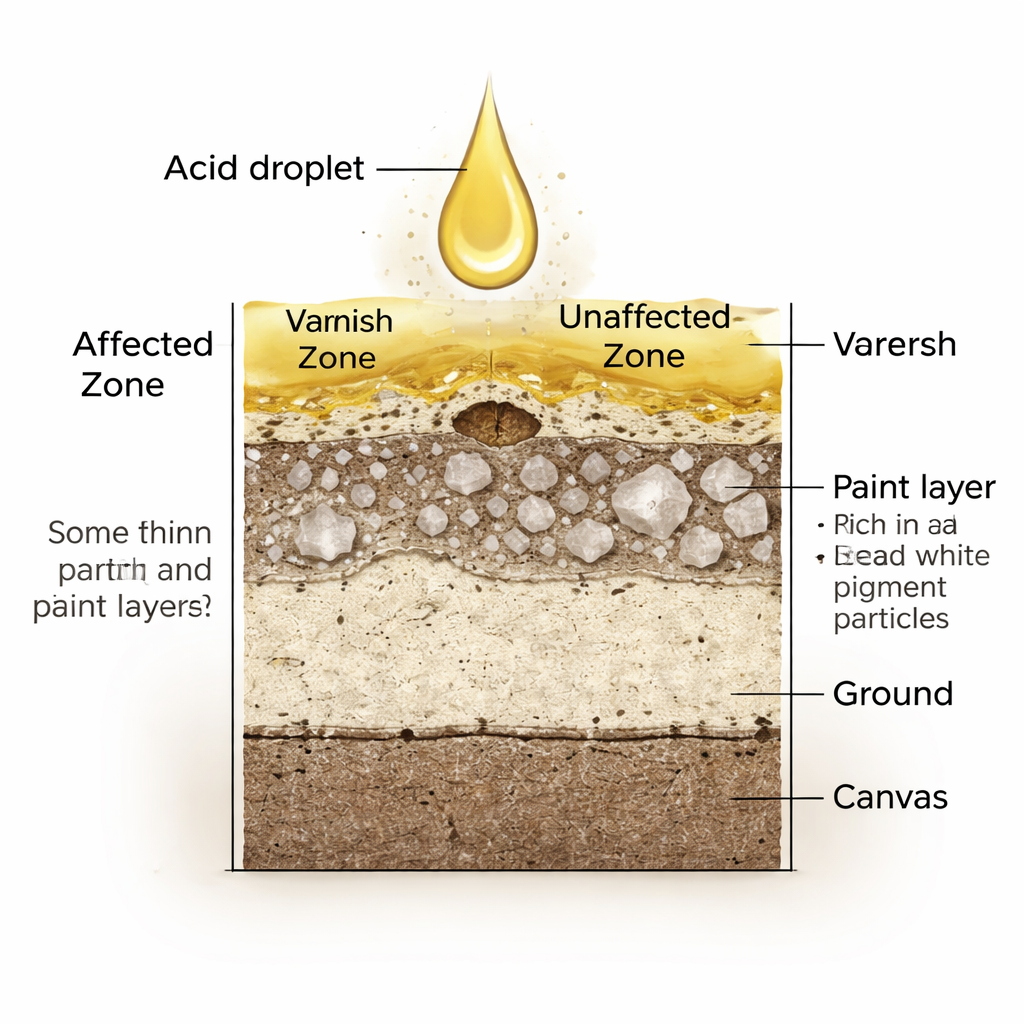
To probe the surface without harming it, the team used several advanced techniques usually found in physics labs. Macroscopic X-ray fluorescence scanning mapped chemical elements across the painted scene, while X-ray diffraction imaging revealed the crystalline compounds present in the very top layers. Optical coherence tomography, a light-based method also used in eye exams, measured the thickness and condition of the varnish. Small paint samples from both affected and nearby unaffected spots were then examined under powerful microscopes and analysed with synchrotron X-rays. Together, these methods showed that in the acid trails the varnish is thinner, the tops of brushstrokes are flattened and pitted, and the paint surface has become porous and slightly whitened compared with its surroundings. Crucially, the scientists identified a new crust of a mineral called anglesite—lead sulphate—formed when the acid reacted with lead white pigment, mainly within about 5–10 micrometres of the surface, and up to 30–40 micrometres where acid drips lingered longest.
Recreating The Attack In The Lab
Because it is impossible to experiment directly on Rembrandt’s original, the researchers built carefully layered mock-up samples that mimicked his materials: oil-based ground layers, paints with different amounts of lead white, and optional varnish on top. They then sprinkled these samples with concentrated sulphuric acid for controlled times, rinsed them thoroughly with water and aged them in a climate chamber. X-ray studies of these test pieces confirmed that anglesite forms readily when lead white is present, even in modest amounts, and that longer acid contact produces thicker crusts. Surprisingly, samples that still had varnish sometimes showed anglesite forming deeper into the paint, suggesting that partially dissolved varnish can trap traces of acid and keep them reacting unless that varnish is later removed.
What This Means For The Painting’s Future
For a casual viewer, The Night Watch today looks intact: the dramatic group of militiamen remains as compelling as ever. This study shows, however, that the acid attack did leave a shallow but real scar in the form of weakened, porous paint and a thin crust of anglesite in lead-rich areas. The damage is mostly confined to the very surface, thanks in large part to the rapid dousing with clean water and the protective varnish present in 1990. As conservators now plan a full removal of the old varnish, they expect the acid trails to become more visible, but also know where the paint is fragile and may need gentle consolidation. More broadly, the work confirms that swift, well-planned emergency rinsing can save paintings from far worse harm, while also highlighting the need to tailor such responses to the specific materials and condition of each artwork.
Citation: Raven, L., Gestels, A., van Loon, A. et al. The acid attack (1990) on Rembrandt’s The Night Watch (1642). Reassessing the painting’s condition through a multimodal analytical approach. npj Herit. Sci. 14, 130 (2026). https://doi.org/10.1038/s40494-025-02233-5
Keywords: art conservation, Rembrandt, acid attack, oil paintings, cultural heritage