Clear Sky Science · en
Scribe identification for Tang Dynasty Changsha Kiln poetic ceramics via dual-path multi-scale global attention model
Poems on Clay, Stories of People
On the surface of small Tang Dynasty porcelain pots and pillows, graceful lines of poetry were brushed over wet glaze more than a thousand years ago. These brief verses are treasured today not only for their beauty, but also for what they could reveal about the people who wrote them. Yet until now, linking a particular inscription to a particular scribe has relied on the trained eye of a few experts. This study shows how modern artificial intelligence can help read the human hand behind these fragile artifacts, opening a new window into everyday life, work, and trade in early medieval China.
Why These Pots Matter
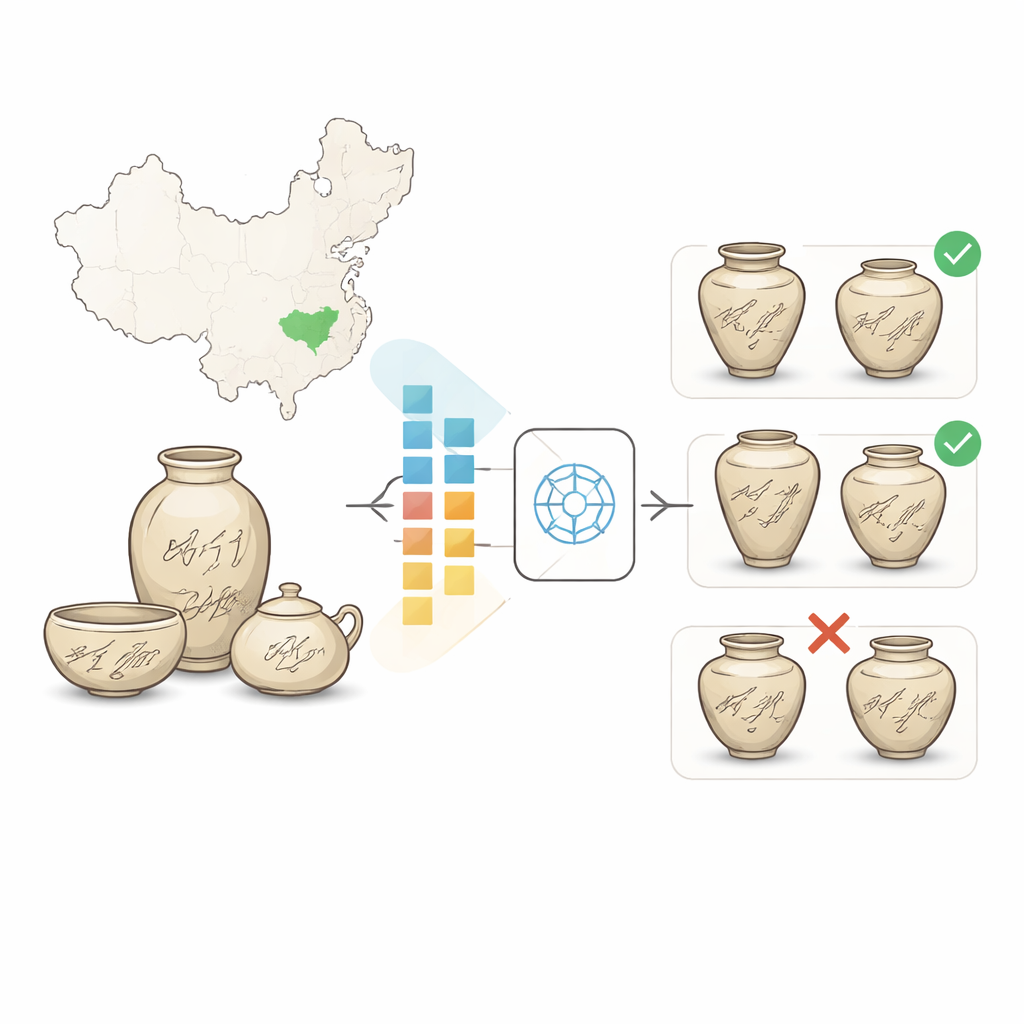
The Changsha Kiln, active during the flourishing Tang Dynasty, produced colorful ceramics decorated with painting, calligraphy, and poetry. These objects travelled widely along early trade routes and became carriers of literature and taste, as well as practical vessels. Their inscriptions preserve not just text but also the energy of the brush strokes and the choices of individual writers. However, most surviving pieces are scattered across museums and private collections, and high-quality images are scarce. No public, standardized image dataset of these inscriptions existed, making it hard for researchers to compare pieces, test digital methods, or ask basic questions such as: Did one potter-scribe write the poems on several different vessels?
Building a Digital Library of Tang Handwriting
To tackle this, the authors first assembled a new image collection from published catalogues of Changsha ceramics. From 135 individual artifacts—mostly ewers, dishes, and pillows bearing poetry or brief notes—they carefully extracted 1,865 single-character images. Because inscriptions lie on curved pottery surfaces, characters near the sides appear distorted in photographs. The team used a specialized image-segmentation and surface-flattening process to correct this curvature, then cleaned away dirt and cracks, converted images to grayscale, resized them, reduced noise, and slightly flipped some images to increase variety. The result is the first dedicated dataset of Changsha Kiln poetic handwriting, a resource that can support script recognition, style analysis, and many other studies in the future.
Teaching a Neural Network to See Style
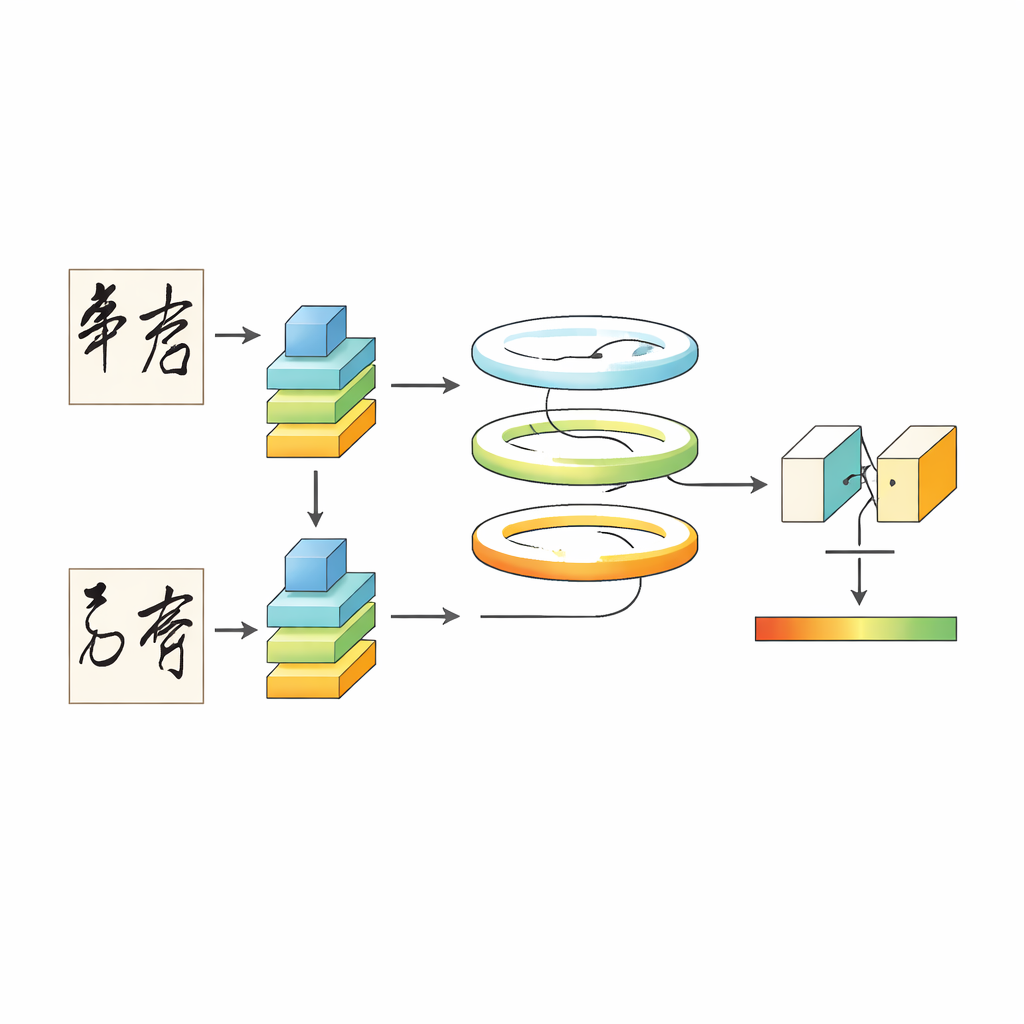
With this dataset, the researchers designed a computer vision system whose job is to decide whether two character images were likely written by the same person. The model takes in a pair of characters through two parallel channels that share the same processing steps. After basic filtering, both images pass through a deep neural network (ResNet-34) that extracts patterns in stroke thickness, curves, spacing, and other subtle features. At the heart of the system is a new multi-scale global attention module. Instead of only looking at one fixed level of detail, this module examines the characters at several scales at once—from coarse layout down to fine stroke wiggles—and learns how distant parts of a stroke relate to each other. By combining these views, the model builds a rich internal “fingerprint” of each scribe’s style and then compares the two fingerprints to output a similarity score between 0 and 1.
Putting the System to the Test
The team compared several popular neural network backbones and attention mechanisms and found that their dual-path network with the new attention module performed best. It reached a recognition accuracy of about 97.9%, clearly surpassing older, single-scale attention models. To see what the algorithm had learned, the authors generated heatmaps that show where the network “looks” most closely. These highlight stroke turns, slanted left strokes, and other regions where brush pressure and rhythm differ from person to person—much like what a human connoisseur would examine. The researchers then ran large batch tests within individual artifacts and between different artifacts. Within a single pot, the system consistently judged all characters to be highly similar, supporting the idea that each vessel’s poem was written by one scribe rather than several.
New Clues About Ancient Craftsmen
The most striking result came when the model compared pieces from different collections. Two ceramic pillows inscribed with love-themed seven-character poems showed very high stylistic similarity, even though they are now housed in separate institutions. Archeological records place both pillows at the same kiln site, and their shapes, decorative motifs, and themes match closely. The algorithm’s verdict—an 85.8% probability that the same hand wrote both inscriptions—backs the conclusion that they were made by a single scribe. In contrast, three similar wine ewers carrying related warning verses about regret showed low similarity scores, suggesting three different calligraphers copying a shared textual formula. Together, these findings reveal how an AI “eye” can help historians trace workshop organization, division of labor, and trade practices.
What This Means for the Past and the Future
By combining careful digital imaging with a sophisticated neural network, this study turns fragile ink traces on pottery into quantitative evidence about who wrote what. For the general reader, the key takeaway is that computer vision can now distinguish individual hands in ancient calligraphy nearly as reliably as a human expert, but far faster and across far more objects. That makes it possible to link pieces scattered around the world, map the careers of long-forgotten artisans, and better understand how mass production and personal expression coexisted in the Tang Dynasty. Although the method is not perfect and depends on limited, sometimes damaged data, it offers a powerful new tool for museums and scholars—and a model for applying AI to many other kinds of historical handwriting.
Citation: Jiang, C., Li, M., Guo, Y. et al. Scribe identification for Tang Dynasty Changsha Kiln poetic ceramics via dual-path multi-scale global attention model. npj Herit. Sci. 14, 146 (2026). https://doi.org/10.1038/s40494-025-02152-5
Keywords: ancient handwriting, Tang Dynasty ceramics, scribe identification, deep learning, digital heritage